
air purifier for candle and incense smoke is a specific search because these sources produce both fine particles and gases. This guide explains what actually helps and how to choose the right machine for your room.
As an Amazon Associate, AirPurifierFAQ earns from qualifying purchases. We link to the live listing so you always see the current price.
Our picks for air purifier for candle and incense smoke
BLUEAIRBLUEAIR Air Purifiers for Home Large Room up to 3,235 Ft², 211i…Covers up to 3,235 sq ft · HEPABLUEAIR — fits very large open spaces with HEPA and smart controls for whole-house style coverage.Check today’s price on Amazon LevoitLevoit PlasmaPro 600S-P Smart Air Purifier with WiFi, WhiteCovers up to 2,956 sq ftLevoit — fits users who want wide coverage plus Wi‑Fi and smart modes; verify filter media for gases.Check today’s price on Amazon
 CowayCOWAY Airmega Halo HEPA Air Purifier for Pets & Allergy, AP-1526D(W), WhiteCovers up to 1,898 sq ft · HEPACOWAY — fits medium to large rooms where particle removal (pets, smoke particles) is the priority.Check today’s price on Amazon
 Rabbit AirRabbit Air A3 SPA-1000N HEPA Air Purifier, Toxin Absorber, BlackCovers up to 1,070 sq ft · True HEPA + Activated CarbonRabbit Air — fits users who need both True HEPA and an activated carbon toxin absorber for particles and odors.Check today’s price on Amazon
 IQAirIQAir HealthPro Plus XE Air Purifier HyperHEPA WiFi, Large Rooms 1125 sq…Covers up to 1,125 sq ft · True HEPAIQAir — fits large rooms needing high-performance True HEPA and smart features; consider carbon for gas control.Check today’s price on Amazon
The specific problem: what candle and incense smoke actually puts into air
Candles and incense release two main types of pollutants. First, they emit fine particulate matter. These particles float in the air and can make a room look hazy. Second, they release volatile organic compounds (VOCs) and odors. These are gases that HEPA filters do not remove well.
You need two things to address both types. A True HEPA or high-efficiency particle filter removes the fine particles, and an activated carbon stage helps adsorb gases and smells. Also, the purifier must move enough air per minute to capture smoke before it spreads around a room.
For more background, see the U.S. EPA’s guide to air cleaners in the home.
How to size a purifier (CADR rule) for candle and incense smoke
Size matters more than brand when dealing with smoke. For example, use this rule: CADR in cubic feet per minute should be about two thirds of the room area in square feet. This gives a fast enough air exchange to capture smoke before it disperses.
So, in a 150 sq ft bedroom, aim for a CADR around 100 cfm. In addition, a higher CADR helps when you burn larger candles or incense, because smoke pulses can be strong. However, higher CADR units can be louder and use more energy, so balance needs and comfort.
Finally, if you plan to run the unit on low fan speed for quiet nights, choose a purifier whose high speed CADR meets the two-thirds rule. That ensures it still has enough capacity when set to a quieter mode.
Filter types that matter: True HEPA and activated carbon
True HEPA is essential for particle removal. HEPA captures very small particles in smoke. As a result, a purifier with True HEPA will reduce visible haze and the tiny particles that spread around a room.
However, HEPA does not remove gases and odors well. That is where activated carbon helps. Activated carbon adsorbs VOCs and many smoke odors. For example, a dedicated carbon layer or a toxin-absorber stage will reduce smell from incense and scented candles.
Also, higher amounts of carbon or larger carbon surface area work better. Some purifiers combine True HEPA and a substantial activated carbon stage to address both parts of smoke. Finally, avoid units that claim odor removal but list no carbon or toxin-absorber media in their specs.
Noise, running cost, and real-world operation
Noise is a practical concern because you may run a purifier while you relax or sleep. Higher fan speeds move more air but they also make more noise. For example, a unit you can run on low for quiet hours but that still meets the CADR rule on high gives flexibility.
Energy and filter replacement determine running cost. Also, more powerful motors and larger fans often use more electricity. As a result, check a model’s energy use and the expected filter life in the manual before buying. In addition, choose filters with replaceable carbon inserts if you burn incense regularly, because carbon reaches capacity faster than HEPA.
Placement tips to maximize smoke removal
Put the purifier close to the source. If you usually burn incense on a table, place the unit nearby and a bit higher than the source if possible. Smoke rises and spreads, so capturing it early reduces room-wide buildup.
Avoid corners and blocked intakes. Fans need an open path to pull air in. Also, center-mounted units work well when the source moves between spots, because they can draw air from multiple directions. Finally, run the purifier on a medium or high setting while burning, then keep it on low for 30 minutes afterward to clear lingering gases.
Common mistakes to avoid when choosing an air purifier for candle and incense smoke
- Relying on HEPA alone: HEPA removes particles but not gases, so also get carbon if you burn scented products.
- Undersizing the unit: Picking a purifier with CADR too low for the room will give slow results, and smoke will spread before it is captured.
- Ignoring filter details: Some designs list a HEPA-type filter but not True HEPA, and others show little or no carbon. Instead, choose units that clearly state True HEPA and activated carbon or toxin-absorber media.
- Placement mistakes: Putting the unit blocked by furniture or far from the source reduces effectiveness. Instead, place it nearby and keep intakes clear.
- Assuming silent equals adequate: Very quiet units may have low airflow. Check CADR, not just noise numbers, because some quiet purifiers are underpowered for smoke control.
Recommended models and who they suit
Below are five models that fit different needs. Use the CADR rule and filter info above to match a model to your room and habits.
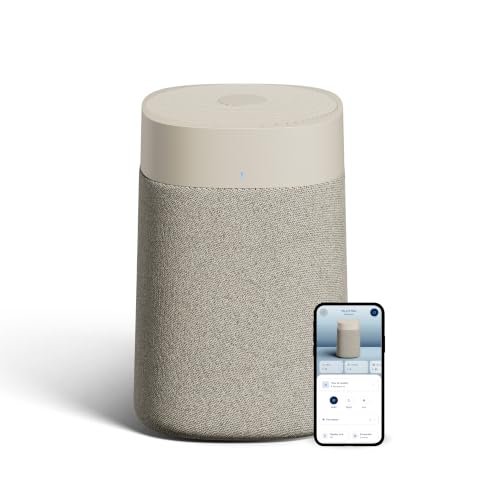
BLUEAIR Air Purifiers for Home Large Room up to 3,235 Ft², 211i Max Beige
Why it fits: very large coverage and HEPA filtration with app control and an air quality sensor make this a choice for big open spaces. Also, the high coverage means fewer units are needed for large living areas. However, ensure the unit’s CADR meets the two-thirds rule for your specific room size.
Levoit PlasmaPro 600S-P Smart Air Purifier with WiFi, White
Why it fits: wide coverage and smart features like Wi‑Fi, Auto Mode, and Sleep Mode may appeal to tech-forward users. Also, the provided facts do not list a specific filter type here, so confirm the presence of True HEPA and a carbon stage in the official product specs before relying on it for gas removal.
COWAY Airmega Halo HEPA Air Purifier for Pets & Allergy, AP-1526D(W), White
Why it fits: strong coverage and HEPA filtration suit medium to large rooms where particle removal is the top priority. In addition, this model is a sensible pick when pet dander and smoke particles are both concerns, but consider adding carbon if odors are strong.
Rabbit Air A3 SPA-1000N HEPA Air Purifier, Toxin Absorber, Black
Why it fits: combines True HEPA with an activated carbon toxin absorber, so it handles particles and gases together. As a result, this model is a good match for regular candle and incense users who want both particle capture and odor/VOC reduction.
IQAir HealthPro Plus XE Air Purifier HyperHEPA WiFi, Large Rooms 1125 sq ft
Why it fits: True HEPA filtration and Wi‑Fi with an air quality sensor make this a strong option for larger rooms that need sustained particle removal. Also, check whether a dedicated carbon stage is included or available as an accessory if you need stronger gas and odor control.
Pick the Rabbit Air model when both particle and gas removal are priorities, choose BLUEAIR or Levoit for very large coverage needs, and consider Coway or IQAir for strong particle performance in medium to large rooms.
Not sure what size you need? Our free size calculator tells you the right CADR for your room in 30 seconds.
Frequently asked questions
Will any air purifier remove the smell of incense or scented candles?
Not all purifiers remove the smell. HEPA filters capture particles but not most gases. For odors and VOCs you need activated carbon or a dedicated toxin-absorber stage. Also, more carbon surface area generally removes smells better.
How long should I run the purifier after burning incense or a candle?
Run the purifier on a medium or high setting while burning, then continue for at least 20–30 minutes afterward. This helps clear lingering particles and gives carbon time to adsorb gases. For stronger smells, run longer or on a higher setting.
Can I rely on a small purifier in a large room if it has a HEPA filter?
No. A small purifier with low CADR will be too slow to capture smoke in a large room. Instead, choose a unit whose CADR (cfm) is about two thirds of the room area in square feet. Otherwise smoke will spread before the purifier can remove it.
How often do I need to replace carbon or HEPA filters when I burn incense regularly?
Carbon filters saturate faster than HEPA when exposed to frequent gases and odors. Replace carbon more often according to the manufacturer's schedule or when odors return. Also, check HEPA life and change it per the manual to maintain particle capture.
Are air purifiers with ionizers or plasma needed for smoke?
Ionizers and plasma technologies can change particle behavior, but they do not reliably remove gases and can produce ozone in some designs. Instead, prioritize True HEPA plus activated carbon for predictable particle and odor reduction.
Black Friday and Cyber Monday 2026: see our hand-picked air purifier and filter deals.
