

Silanit
Desktop Smoke Purifier Fan, Portable USB Rechargeable Adjustable Angle…
BrandSilanitFilterWashable Filter
$43.99
View product details
Product information comes from the current AirPurifierFAQ catalog and should be verified on Amazon before purchase.


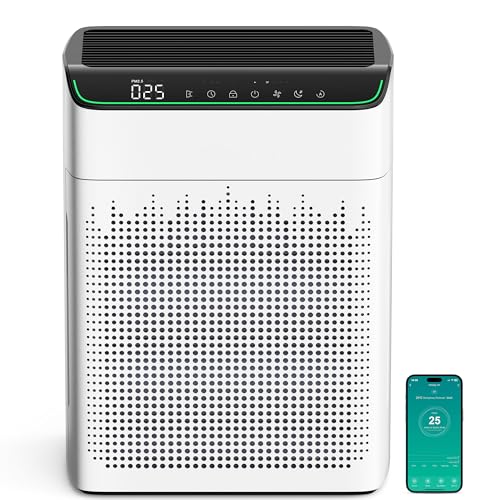

IQAir HealthPro Plus XE — Best overall for wildfire smoke. Its HyperHEPA filtration (rated to 0.003 microns), large listed coverage (1,125 sq ft) and built‑in air sensor make it the strongest supplied spec set for reducing fine smoke particles in living rooms and whole bedrooms; follow the product link to check current pricing and availability.
See the IQAir HealthPro Plus XE on AirPurifierFAQ
This roundup is written for anyone facing wildfire smoke events who needs a practical, specification‑driven recommendation for specific rooms and budgets. That includes:
The guide only uses product facts supplied by the manufacturers and the product pages linked above. If an important spec is missing from the listing (CADR, decibel level, or filter cost), that absence is flagged: verify it with the seller before buying.
Wildfire smoke is primarily a fine‑particle problem (PM2.5 and smaller), often accompanied by smoke odor. For this reason the selection criteria prioritized the following manufacturer‑stated features:
We did not invent or estimate CADR values, filter costs, or noise levels where manufacturers did not supply them. Models are presented with the specifications the manufacturer published on the product page linked above.
Why it’s here: IQAir’s listing highlights HyperHEPA filtration rated to 0.003 microns and coverage up to 1,125 sq ft—two manufacturer‑supplied facts that matter in smoke events. The product also lists Wi‑Fi and an air quality sensor and carries a 10‑year limited warranty on the product as stated.
Recommended use: primary living room or master bedroom where you want a single, high‑capacity unit to run continuously during prolonged poor‑air episodes. The emphasis in the listing is on particle removal down to submicron sizes; that’s central to clearing PM2.5 from indoor air.
Things to check before you buy: the product page does not publish CADR or noise numbers in the supplied data. If CADR or noise is crucial for your decision, confirm those values with the seller or dealer.
Why it’s here: Pureborne’s PB6866 lists a manufacturer coverage claim of 3,600 sq ft and a H13 True HEPA + activated carbon filter. It also includes real‑time PM2.5 sensing, auto and sleep modes, and a three‑sided air intake designed to speed purification.
Recommended use: homeowners who want a single, mobile unit the manufacturer positions as capable of whole‑home circulation (manufacturer claims one air change per hour for the stated coverage). This model is attractive where coverage area in the listing matters more than a CADR number.
Things to check before you buy: the listing does not include a CADR figure or decibel specification in the supplied product data. Confirm noise level and expected filter replacement costs if those matter to you.
Why it’s here: MERONTE’s MR7566‑WF lists True HEPA + activated carbon filtration, coverage up to 3,600 sq ft, and explicitly lists 23 dB for sleep mode. It also supports Wi‑Fi and a real‑time PM2.5 display.
Recommended use: large living areas or bedrooms where low night noise and an on‑device air‑quality display matter. The activated carbon layer is useful for reducing smoke odors in addition to particle capture.
Things to check before you buy: CADR isn’t supplied on the product page. The manufacturer lists a filter life estimate of up to 2,200 hours for some MERONTE models (see MR5866 data), but confirm the MR7566‑WF’s recommended filter replacement interval and filter price.
Why it’s here: This MERONTE listing supplies an airflow figure—Clean Air Delivery Rate listed as 200 CFM (340 m³/h)—and coverage up to 1,690 sq ft. It includes a HEPA filter, two long‑life filters included with the purchase, and smart features (Wi‑Fi, Alexa, Google Assistant).
Recommended use: buyers who want a manufacturer‑stated airflow number to pair with their room measurements. The listing’s included airflow and coverage numbers make it easier to estimate air changes per hour for your specific space compared with models that only declare coverage.
Things to check before you buy: double‑check whether the included filters are the same as the replacement filters sold separately and ask the seller about replacement cost and availability if you plan extended heavy use during smoke events.
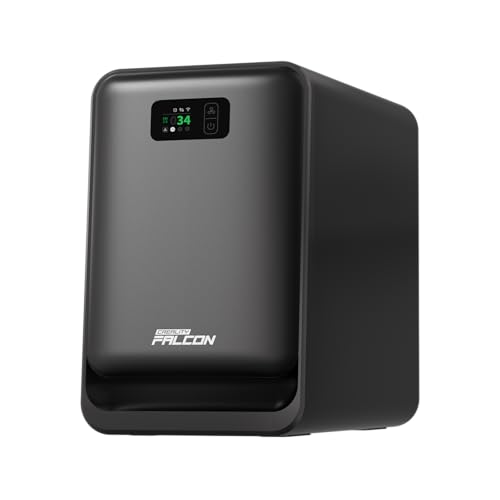
Why it’s here: The Creality Falcon AP1 is explicitly designed for laser‑engraving setups and lists a five‑stage filtration system, built‑in PM2.5 sensing, automatic syncing with a laser engraver via Wi‑Fi, and a 360° air intake. Its product page describes it as compact yet powerful for home workshops and studios.
Recommended use: hobbyists and small business owners who run desktop laser cutters and need a purifier that starts with the machine and focuses on local smoke and fume capture. The Falcon AP1 is a targeted solution for workshop smoke rather than whole‑room or whole‑house coverage.
Things to check before you buy: the manufacturer does not publish a whole‑room coverage number or CADR in the supplied listing, so use this model as a localized source‑capture device rather than a primary living‑area purifier unless you confirm whole‑room performance.
Why it’s here: Silanit’s small USB‑powered unit lists a washable, removable filter, an oil collection cup useful for cooking fumes, and adjustable tilt to target local sources. It’s inexpensive in the supplied listing and designed for personal or small‑area use.
Recommended use: apartments, RVs, kitchens, or any situation where you want a local extractor that captures immediate cooking smoke or small‑scale indoor smoking. Because the unit uses a washable filter, it avoids repeated filter purchases—but performance is limited to local source control rather than whole‑room air changes.
Things to check before you buy: the product page does not list CADR or room coverage. If your goal is to lower room‑wide PM2.5 during a wildfire event, treat this as a supplemental device and prefer a True HEPA‑equipped whole‑room purifier for larger spaces.
View Silanit Desktop Smoke Purifier Fan
Why it’s here: This two‑pack replacement filter is compatible with many Dyson 360‑degree models and combines True HEPA with activated carbon. The listing notes particle capture down to 0.3 microns for the HEPA element and recommends replacement every 6–12 months depending on use.
Recommended use: owners of compatible Dyson 360° models who need a replacement filter optimized for particle capture plus smoke odor adsorption. Having replacement filters on hand is useful during prolonged smoke events when carbon layers can saturate faster.
Things to check before you buy: filter compatibility depends on your exact purifier model—verify the model numbers the listing supplies before purchasing.
View LemonQueen replacement filters
Why it’s here: The dreame AP10 emphasizes pet hair capture with a 360° intake and a visible hair collection compartment; published noise in the listing is 31.9 dB. It uses multi‑stage filtration and provides an app for remote control per the supplied product data.
Recommended use: pet owners who need a quiet, integrated solution for hair, dander and general particulate control. While the listing calls out airborne hair capture and auto modes, it does not publish a coverage area or CADR in the supplied data, so confirm those if you need whole‑room performance for wildfire smoke.
Manufacturer‑listed coverage (sq ft) is the quickest way to match a unit to a room when CADR isn’t supplied. Use that listed coverage and place the unit where it can circulate air unimpeded: near the center of the room or along a main traffic line, with doors and windows closed while operating.
If the manufacturer supplies CADR or airflow (for example the MERONTE MR5866 lists 200 CFM), you can estimate air changes per hour (ACH) for a room and compare that to your target. During heavy smoke, more frequent air changes (higher ACH) reduce indoor particle concentrations faster.
Smoke consists of fine particles and volatile compounds that cause odor. Where the manufacturer lists both a True HEPA filter and an activated carbon/charcoal layer, the HEPA addresses particles while the carbon layer helps with odor and volatile components. Several models in this roundup explicitly list both (Pureborne PB6866, MERONTE MR7566‑WF, LemonQueen replacement filters).
A purifier that includes a PM2.5 sensor and an auto mode (both cited in multiple product listings here) will ramp fan speed only when needed, giving you real‑time feedback and more efficient operation. If you expect intermittent smoke, a sensor can keep background noise and power use lower until the purifier detects a smoke spike.
If you need to capture smoke at its source—laser engraving, a small cooktop, or a local smoking area—a dedicated source‑capture or desktop unit (Creality Falcon AP1, Silanit) is appropriate. These are designed to operate next to the source and may not deliver whole‑room ACH. For living rooms or bedrooms choose a manufacturer‑listed room‑coverage unit with True HEPA and, ideally, carbon.
Noise matters if you’ll run the purifier at high speeds at night. The MERONTE MR7566‑WF lists 23 dB in sleep mode and dreame lists 31.9 dB. Many manufacturers don’t publish complete noise curves—confirm if quiet overnight operation is essential. During severe smoke, run the purifier continuously; place it away from walls and obstructions so air can circulate freely.
Filter replacement frequency and cost are a major operating expense during prolonged smoke seasons. A few listings supply filter life guidance—MERONTE cited up to 2,200 hours for included filters, LemonQueen recommends 6–12 month replacement—while many do not publish replacement cost. Before you buy, confirm the replacement filter type and cost from the seller so you can budget for heavy use.
Use the following decision prompts to narrow to a single unit or a combination that makes sense for your household.
Choose the IQAir HealthPro Plus XE if the manufacturer‑supplied HyperHEPA rating and 1,125 sq ft coverage match your space and budget. It’s the most specification‑forward “whole‑room” pick in this roundup.
Consider Pureborne PB6866 or MERONTE MR7566‑WF—they both list 3,600 sq ft coverage. Pureborne emphasizes a three‑sided intake and H13 True HEPA with carbon; MERONTE adds a quiet sleep mode listing (23 dB) and Wi‑Fi control.
Use MERONTE MR5866’s supplied 200 CFM number to calculate air changes per hour for your room. That makes it easier to verify whether it will meet your ACH target for severe smoke episodes.
The Creality Falcon AP1 is designed for desktop source capture; it includes five‑stage filtration and synchronizes with laser equipment via Wi‑Fi per the supplied listing.
The Silanit desktop purifier offers a low initial price and a washable filter for short‑term, localized smoke or cooking fumes. It’s not a substitute for a True HEPA whole‑room purifier when wildfire smoke fills a home.
A few clarifications to prevent common mistakes:
If you still aren’t sure which model to buy, use these short scenarios.
For deeper background on performance metrics, how to calculate room size vs CADR, and other use‑case comparisons, see our reviews and buying resources:
An air purifier with True HEPA filtration can reduce indoor particle concentrations when used correctly (sealed windows/doors, run continuously). It’s one tool to lower indoor particulate levels; follow local public‑health and evacuation guidance when conditions are hazardous.
Use the manufacturer‑listed room coverage or CADR/airflow to match the unit to your room dimensions. If the product supplies CADR or airflow (for example MR5866 lists 200 CFM), you can calculate air changes per hour; otherwise rely on the manufacturer’s stated coverage. During heavy smoke, aim for higher ACH by running the unit at higher fan speeds or using multiple units.
Carbon helps reduce smoke odor and some volatile compounds. If the manufacturer lists an activated carbon layer (several units above do), that’s a benefit for odor reduction. However, particle removal requires proper HEPA filtration—prefer models that list both HEPA and carbon when possible.
Filter life depends on smoke intensity and the purifier’s carbon loading. Manufacturers sometimes publish filter‑life guidance (example: LemonQueen recommends replacing 6–12 months; MERONTE references up to 2,200 hours on some models). If you experience persistent smoke or odor, plan for more frequent replacements and verify replacement costs before purchase.
Typically no. Small USB or desktop purifiers (for example the Silanit unit listed here) are intended for local source capture or personal zones. For whole‑room protection during wildfire smoke, choose a unit with manufacturer‑stated room coverage or CADR appropriate to your room volume.
Ask about CADR (or measured airflow), published noise (dB) at different fan speeds, the exact composition and weight of activated carbon (if odor control is a priority), warranty details, and the cost and availability of replacement filters. Several product pages in this guide omit one or more of these values—verify them if they affect your decision.
Wildfire smoke events vary by duration and intensity. This guide uses only the manufacturer‑supplied facts linked from each product page. If you want a single recommendation for a primary living space and have the budget, the IQAir HealthPro Plus XE is the strongest supplied spec set here for particle removal. For broad, lower‑cost coverage claims, Pureborne and MERONTE list larger coverage areas; for localized source capture, choose Creality or a portable desktop extractor. Confirm missing specifications with the seller when needed, and plan filter replacements before heavy smoke seasons.
Both metrics matter: listed coverage gives a manufacturer’s recommended room size, while CADR (or airflow/CFM) is the measurable airflow that determines actual air changes. Choose units that supply CADR/airflow when you need precise ACH estimates; if a listing lacks CADR, confirm that value with the seller. The MERONTE MR5866 is an example that supplies an airflow figure to aid calculations.
Wildfire smoke is mainly fine particles but often includes odor and gaseous compounds. True HEPA or HyperHEPA captures particles; activated carbon or charcoal can reduce smoke odor and some gases. Several models in the roundup list activated carbon (for example, Pureborne PB6866 and MERONTE MR7566). If odor removal is important, verify the product’s carbon stage and its specification on the product page.
You need an airflow metric (CADR or CFM) and your room’s dimensions to estimate ACH. Models that publish airflow—like the MERONTE MR5866, which lists 200 CFM—make that easier. If a model only lists coverage in square feet, the figure is a manufacturer claim; ask the seller for CADR/CFM if you require a specific ACH target.
The roundup prioritized on-device PM2.5 sensors and auto modes because they can adjust fan speed in response to particle levels, which is useful during fluctuating smoke events. Several featured models include real-time PM2.5 displays and auto settings (IQAir HealthPro Plus XE, Pureborne PB6866, MERONTE models). If sensor control matters, confirm the presence of a real-time PM2.5 sensor on the product page.
Confirm filter type (True HEPA/HyperHEPA), whether activated carbon is included, listed filter life, and whether replacement filters are the same as the included ones. The MERONTE MR5866 includes two long-life filters; some MERONTE listings note filter-life estimates for related models. IQAir’s listing also states a 10-year limited warranty. Verify replacement cost and recommended replacement intervals on the product page or with the seller.
The Creality Falcon AP1 is listed specifically for laser-engraving and workshop setups; the manufacturer shows a five-stage filtration system and built-in PM2.5 sensing. It’s presented as the desktop/workshop pick in the roundup. For any missing spec you care about (CADR, noise, filter cost), check the product page or confirm with the seller before purchasing.
Answers are educational and may link to relevant guides or products on this site. Product facts can change, so confirm current details before purchase.
