
01
Very High Ion Output
Manufacturers state it releases up to 5.6 million negative ions per cm3, a claimed concentration intended to attach odors, smoke, and airborne particulates in vehicle cabins.
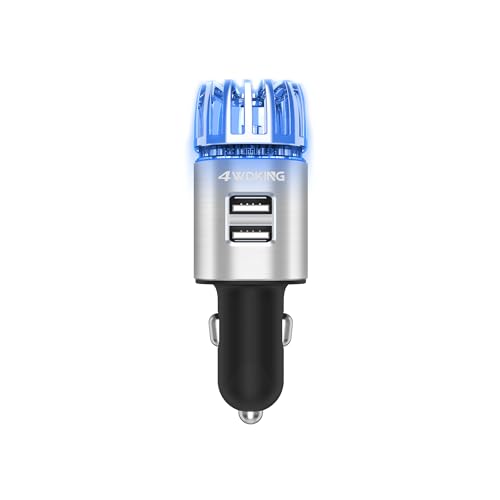
Powerful Odor Eliminator: 4WDKING Ionic Air Purifier can release up to 5.6 million negative ions per cm3, which can immediately remove bad order and smell from the car. These high-density negative ions also attach dust, pollen, allergens, bacteria, viruses, and atmospheric particulate matter (PM2.5) commonly found, and smoke to increase air quality and reduce the odor and smell Efficient Car Odor Remove: The air purifier emits a light scent of ozone that smells similar to a summer rain shower. The negative ion t...
As an Amazon Associate, AirPurifierFAQ earns from qualifying purchases. Product availability, price and specifications can change.
The 4WDKING Car Air Purifier Ionizer with Dual USB Charger is a compact, plug-in vehicle air accessory that the manufacturer markets as an ionic air purifier rather than a mechanical-filter unit. According to the product listing it generates up to 5.6 million negative ions per cm³ and emits a light ozone scent described as similar to a summer rain shower. It plugs into a 12 V outlet, runs continuously while powered, and includes dual 2.1 A USB charging ports, a matte stainless‑steel finish and a small blue LED. The listing does not state CADR, filter type, measured ozone output, noise in dB or room coverage.
This device is explicitly designed for in-vehicle use: it plugs into a 12 V cigarette-lighter socket and advertises a compact shape that should not obstruct nearby controls. The maker positions it as an odor eliminator and smoke reducer for car cabins rather than a whole-home purifier. If you want continuous background treatment while driving, the unit’s plug-and-run design and continuous operation suit that scenario. It also combines a practical function—dual 2.1 A USB ports for charging phones or tablets—so it’s aimed at buyers who value a small-form convenience accessory that also claims to influence cabin air quality.
This model is an ionizer/ozone‑emitting device, not a mechanical filter: the listing highlights negative-ion output (up to 5.6 million ions/cm³) and a light ozone scent. There is no mention of a HEPA or other particulate filter, nor of a fan-driven airflow or CADR rating. That matters because ionizers typically work by charging particles so they clump or settle onto surfaces rather than capturing them in a filter; they don’t provide the same, measurable particle removal pathway as a sealed filter system. If your priority is removing airborne particles continuously from the airstream, verify whether an ionizer-only approach matches your expectations.
The unit is described as a silent ionizer with minimal sound and continuous operation while plugged in, which suggests a low-interaction ownership model: plug it into the vehicle, leave it running, and recharge devices from the USB ports as needed. The listing does not specify replaceable filters or a maintenance schedule, implying a largely filterless device; however the absence of filter information should be confirmed with the seller. The crystal-shaped blue LED helps locate the unit in the dark but might be a minor distraction for some drivers. Also check vehicle compatibility and whether prolonged use while parked is acceptable for your battery and vehicle electronics.
Installation is limited to the vehicle’s 12 V outlet—there are no floor-stand or window-mount options. Because the product relies on ionic output rather than forced-air circulation, placement in relation to vents is less critical than with fan-driven purifiers; still, avoid blocking the socket and ensure the cable and unit do not interfere with gear levers, pedals or passenger space. For best results with an ionizer, many users run such units continuously during trips; keep in mind the product emits a light ozone scent according to the listing, so placement where occupants detect the scent may be a factor in passenger comfort.
The 4WDKING unit combines aesthetics with utility: a matte stainless‑steel exterior and a crystal-shaped blue LED are intended to integrate with modern car interiors and aid location in low light. The product listing does not describe push-button controls, timed modes or adjustable ion output—its operation is described as continuous while plugged in. The dual 2.1 A USB ports are a clear practical advantage for charging phones and tablets during drives; confirm whether that rating is total output or per port if you plan to charge two power-hungry devices simultaneously.
Shoppers who want a compact, plug‑in car accessory that pairs an ionic air-treatment claim with useful dual 2.1 A USB charging ports, and who are comfortable with a filterless, ionizer-style approach to odor and particulate management.
Before purchase verify the missing technical details that affect safety and performance: measured ozone emissions (and whether they comply with regional limits), whether the ion output figure is continuous or peak, whether the USB 2.1 A rating is per port or shared, and whether any filter or washable element exists. The listing lacks CADR, particle-removal testing, noise in decibels, and explicit vehicle-compatibility guidance. If you have respiratory concerns or sensitivity to ozone, consult independent guidance about ozone-producing devices and seek units with documented emission levels. Also confirm the unit’s dimensions against your vehicle’s socket area and check the seller’s current price and availability.
The 4WDKING car ionizer is a compact, low-interaction accessory that combines a manufacturer-stated high ion output with useful dual 2.1 A USB charging. It may suit drivers seeking a small device to reduce odors and provide device charging. However, it is an ionic/ozone-emitting approach rather than a filter-based purifier, and the listing omits key measured specifications—most importantly ozone emission levels, CADR or particle-removal testing and noise figures. Buyers should weigh comfort with an ionizer strategy and confirm missing technical details before relying on it for air-quality needs.
The strongest reasons to consider it, based on the product data we have
Manufacturers state it releases up to 5.6 million negative ions per cm3, a claimed concentration intended to attach odors, smoke, and airborne particulates in vehicle cabins.
Two 2.1 A USB ports provide simultaneous charging for phones or tablets, letting occupants charge devices while the purifier runs during longer car trips.
Matte stainless-steel body with a crystal-shaped blue LED, plug-in fit for cigarette lighter sockets, and reported minimal sound for unobtrusive, space-saving in-car placement.
The listing describes this model as an ionic air purifier and does not specify any filter type or replacement filters. If you need confirmation about filters or scheduled replacements, verify directly with the seller or manufacturer before purchase.
The product listing states the purifier emits a light scent of ozone similar to a summer rain shower and that ozone is most effective over time. The listing does not provide ozone concentration or safety certifications. If you have health concerns, verify the device’s ozone output and any safety certifications with the manufacturer or seller.
Installation is plug-and-play: the unit plugs into a 12V outlet (cigarette lighter) and runs continuously while plugged in. Its compact design is said to fit without obstructing other controls, and a crystal-shaped blue LED helps locate the unit and USB ports in the dark.
Yes. The unit includes dual USB ports, each rated at 2.1 A according to the listing, which supports charging two devices simultaneously. Verify your devices’ charging requirements and your vehicle’s outlet capacity if you plan to charge high-power devices at the same time.
The listing claims the device releases negative ions (up to 5.6 million per cm³) that attach to dust, pollen, allergens, bacteria, viruses and PM2.5 and that it removes smoke and odors. The page does not provide independent test data or certified removal rates; for health-sensitive situations, check for third-party test results or certifications from the seller or manufacturer.
The product description calls the unit a "silent ionizer" with minimal sound but gives no decibel rating, maintenance schedule, or lifespan data. Because those specifics aren’t listed, verify expected operating lifetime, recommended maintenance/cleaning, and noise measurements with the seller or manufacturer.



Answers are educational and may link to relevant guides or products on this site. Product facts can change, so confirm current details before purchase.
