
01
Safe‑Sleep Airflow Design
Dedicated safe‑sleep airflow design that gently circulates clean air across a baby’s breathing zone, targeting CO2 and airborne pollutants for overnight protection according to the product description.
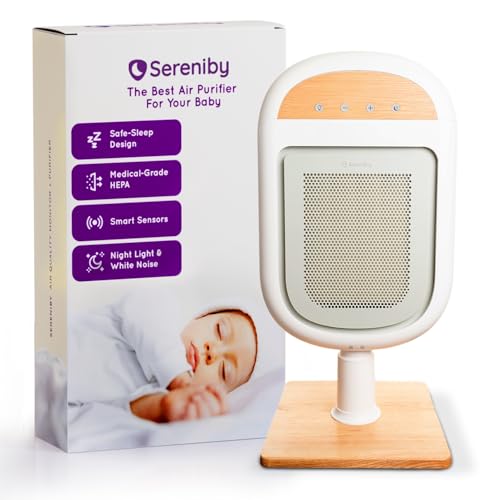
The Only Air Purifier Designed for Safe Sleep – Engineered to gently circulate clean air across your baby’s breathing zone, sweeping away CO₂ and airborne pollutants for complete overnight protection. Medical-Grade HEPA Purification – Uses the same filtration technology trusted in neonatal intensive care units to eliminate viruses, wildfire smoke, pollution, and allergens—up to 5x more effective.
As an Amazon Associate, AirPurifierFAQ earns from qualifying purchases. Product availability, price and specifications can change.
According to the supplied product data, the Sereniby Air Purifier for Baby is positioned as a nursery-focused purifier built around a proprietary “safe‑sleep” design and medical‑grade HEPA filtration. The listing emphasizes laser‑precision air quality and temperature sensors, a parent app, built‑in natural white noise and red sleep lighting, and several baby‑safety features such as tip‑over protection, no exposed fans, and a hidden power cord. Price and availability are provided, but several common technical details (room coverage, CADR, noise levels, filter life and smart‑feature specifics) are not included in the data.
The product is clearly framed for bedrooms and nurseries where overnight sleep and a baby's breathing zone are priorities. The marketing language focuses on gently circulating air around a baby’s sleeping area and on features intended to support restful sleep (natural white noise, subtle red lighting). Buyers should treat this as a purpose‑built nursery unit rather than a general household air mover: the design intent is to integrate with a crib or bedside environment and to minimize disturbance during sleep. The absence of explicit room‑coverage or CADR numbers means you should confirm the unit’s suitability for the actual nursery footprint before relying on it as the primary purifier for a larger shared room.
The listing states the unit uses “medical‑grade HEPA” filtration and references the same filtration technology used in neonatal intensive care. The product copy claims effectiveness against viruses, wildfire smoke, pollution and allergens, and mentions “up to 5x more effective.” Those are product claims; the data does not include independent test results, certifications or a specification such as CADR that would quantify particle removal rate. If particle filtration is a primary purchase driver, ask the seller for third‑party test reports, CADR or documented filter specifications so you can compare performance with other HEPA units on measurable metrics.
According to the supplied description, Sereniby includes a mobile app for remote monitoring and control, plus onboard sensors that provide real‑time air quality and temperature readings and smart alerts tied to WHO and American Academy of Pediatrics guidance. The unit also bundles sleep‑friendly features (white noise, red sleep light) intended to limit sleep disruption. The data does not specify how filters are replaced, expected filter life, or whether the app requires an account/ subscription for full functionality. Prospective owners should verify filter replacement procedure and cost, app platform compatibility, and whether any cloud services are optional or required for core operation.
The product asserts a design that circulates clean air across a baby’s breathing zone and includes laser‑precision environmental sensors and tip‑over protection. For nursery use, placement near but not directly above the crib is typically recommended; however, the data does not include recommended clearance, mounting options or airflow diagrams. The stated baby‑first safety elements (no exposed fans, hidden power cord, rounded edges) are relevant to nurseries, but buyers should confirm specifics such as cord length and the exact nature of tip‑over shutoff. Finally, if CO₂ monitoring or reduction is a concern, ask how the unit measures or influences CO₂, since gas management is handled differently than particulate filtration.
Buyers seeking a purifier marketed specifically for nursery or bedside use with sleep‑focused features and an emphasis on baby safety; families who value an integrated app and sensor alerts and who will verify coverage and filter logistics before purchase.
Before purchasing, verify the unit’s effective room size or CADR so you can match it to your nursery. Ask for independent test data or certification if you require verified particle‑removal performance. Confirm filter model, expected replacement interval and cost, plus whether replacement filters are available through multiple channels. Clarify noise levels at night and how the fan behaves in low‑light or sleep modes. If CO₂ detection or reduction is a priority, get specifics on what the sensor measures and how the purifier affects indoor CO₂. Finally, check app compatibility (iOS/Android), whether alerts are local or cloud‑based, and any ongoing subscription requirements.
The Sereniby Air Purifier for Baby is presented as a nursery‑centric purifier with sleep‑friendly design and built‑in sensor monitoring. Its baby‑safety details and integrated white‑noise and red‑light features address practical needs for overnight use. However, the product data omits key technical metrics—CADR, room coverage, noise figures and filter life—that are needed to assess raw cleaning performance and operating cost. If you are considering this unit, confirm those specifications and any independent test results with the seller so you can evaluate whether it will meet your nursery’s size and performance expectations.
The strongest reasons to consider it, based on the product data we have
Dedicated safe‑sleep airflow design that gently circulates clean air across a baby’s breathing zone, targeting CO2 and airborne pollutants for overnight protection according to the product description.
Medical‑grade HEPA filtration, described as the same technology used in neonatal intensive care units and stated to be up to five times more effective against smoke, viruses, pollution, and allergens.
Laser‑precision air quality and temperature sensors provide real‑time monitoring and smart alerts claimed to follow WHO and American Academy of Pediatrics guidance for responsive notifications.
The page doesn’t list a replacement interval. Check the Sereniby product manual, packaging, or the app for recommended filter life and replacement reminders. Also verify availability and part number for replacement filters before purchase so you can keep the unit operating at peak performance.
Room coverage and CADR aren’t specified in the provided details. Confirm the recommended square footage, CADR, or ACH (air changes per hour) with Sereniby or the product listing to ensure it’s appropriate for your nursery or bedroom.
The product is listed under “Quiet Air Purifiers” and includes a sleep-friendly design with built-in natural white noise, suggesting it’s intended for overnight use. The exact decibel levels and fan speed options aren’t given here—verify the measured noise (dB) at different speeds or look for user reviews if sound level is a key factor.
Sereniby is marketed with a proprietary safe-sleep design: tip-over protection, no exposed fans or sharp edges, and a hidden power cord. That indicates it’s intended for overnight nursery use, but if you need specific safety certifications or electrical/safety test results, verify those details with Sereniby or the product documentation.
The unit features laser-precision sensors for real-time air quality and temperature monitoring and sends smart alerts based on WHO and American Academy of Pediatrics guidance. The exact pollutants tracked (PM2.5, CO2, VOCs, etc.), alert thresholds, and alert types (push, email, in-app) aren’t listed—check the app description or manual for full sensor and alert details.
According to the product features, Sereniby uses medical-grade HEPA filtration—claimed to be the same technology used in neonatal ICUs—and is said to eliminate viruses, wildfire smoke, pollution, and allergens, up to 5x more effective. For independent verification or specifics about reduction percentages and test conditions, consult Sereniby’s technical data or third-party test reports.


Answers are educational and may link to relevant guides or products on this site. Product facts can change, so confirm current details before purchase.
