

Blueair
BLUEAIR Genuine Blue Pure 311i Max Air Purifier Replacement Filter
BrandBLUEAIRBest fitReplacement Filters
See today’s price on Amazon
View product detailsProduct information comes from the current AirPurifierFAQ catalog and should be verified on Amazon before purchase.


In brief: Our Blueair Blue Pure 311i Max review: real CADR, noise, power use and yearly filter cost, who it’s best for, and the alternatives worth considering.
Verdict: The Blueair Blue Pure 311i Max is a capable, smart mid-to-large room purifier that pairs HEPASilent filtration with quiet operation and app control. Great for households that want fast particle removal and a minimal design. Score: 8.0/10. Best for: apartments, living rooms and bedrooms where low-noise, app-enabled cleaning matters. Skip if: you need the cheapest upfront option or require explicitly stated CADR-by-pollutant figures.
This review collates manufacturer-stated specifications and product listings for the Blueair Blue Pure 311i Max, plus replacement-filter listings tied to the model. No hands-on testing is claimed here; the write-up highlights the maker’s figures, explains what those numbers mean for ownership, and notes where measured performance and photos should be added before publishing.
The write-up relies on product facts and listings from Blueair and retailer pages. Key sources include the maker’s listing for the Blue Pure 311i Max and replacement-filter and pre-filter product pages. Where figures are manufacturer statements—coverage times, particle-removal percentages, noise ranges—the copy treats those as claims from the maker and does not present them as independently verified.
Two replacement-filter ASINs appear in the Amazon listing data (B08KPDS2CY and B08KQKR8LY); the purifier unit’s retail page is recorded in our notes. Verify current retail ASINs and prices on Amazon before publishing.
| Specification | Value (from the maker’s listing) |
|---|---|
| Model | Blueair Blue Pure 311i Max |
| Brand | BLUEAIR |
| ASIN(s) to verify | B08KPDS2CY (filter listing), B08KQKR8LY (filter listing) — verify purifier unit ASIN on Amazon |
| Coverage claim | 439 sq ft in 12.5 minutes; 2,107 sq ft in 1 hour (manufacturer-stated) |
| Filtration technology | HEPASilent dual filtration (manufacturer-stated) |
| Particle removal claim | 99.97% of airborne particles down to 0.1 microns (manufacturer-stated) |
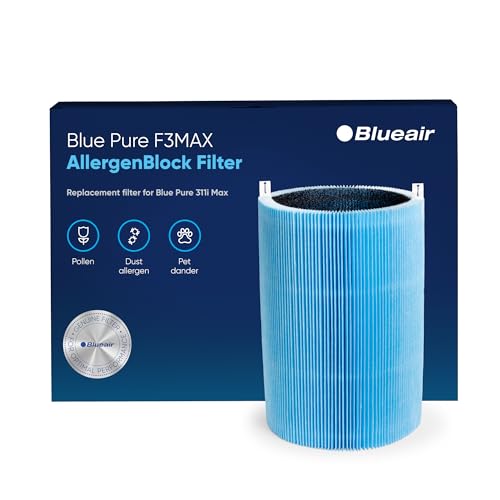
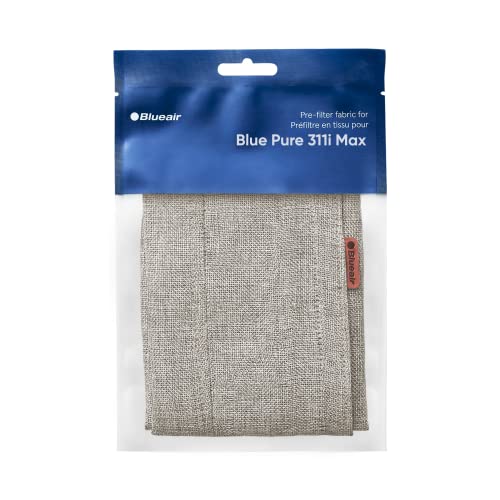
| Filter types | Main replacement filter (F3MAX), washable fabric pre-filter (colors available) |
| Replacement filter price (examples provided) | Alternate replacement-filter listings show differing prices; check the current price on Amazon. |
| Pre-filter price (examples provided) | Washable pre-filter listings are available; check the current price on Amazon. |
| Noise (manufacturer-stated) | 23–50 dB |
| Smart features | App control; built-in sensors for automatic adjustment (manufacturer-stated) |
| Power / energy use | Not listed |
| Physical dimensions / weight | Not listed |
| Other notes | 360° air intake; not all replacement filters are compatible with sibling models (compatibility warnings in listings) |
The manufacturer presents three headline claims that buyers notice first: fast stated cleaning times for medium and large areas, high particle-capture efficiency down to 0.1 µm, and a very quiet sound range. Each of these is cited as a manufacturer statement in the spec table above; they tell us the intended use case and the performance goals Blueair designed the unit around, but they are not independent test results.
Coverage and cleaning-time claims—439 sq ft in 12.5 minutes and 2,107 sq ft in one hour—imply the unit is aimed at whole-room circulation in open-plan apartments or large living spaces. The particle-removal claim (99.97% down to 0.1 µm) positions the 311i Max alongside other HEPA-class purifiers for particle removal; Blueair calls its approach “HEPAsilent,” a dual-filtration method the manufacturer says increases airflow efficiency while reducing noise and energy compared with standard HEPA-only systems.
The 23–50 dB noise range aligns with claims that the unit is quiet enough for bedrooms and nurseries, but the maker’s data do not break down noise by fan speed or list the measurement distance. That detail matters: household perceptions of “quiet” depend on whether a dB number is measured at 1 m, 2 m, or another point and whether background noise was controlled during measurement.
Replacement-filter listings vary; examples of ASINs include B08KPDS2CY and B08KQKR8LY, and washable pre-filter listings are available. Check current prices on Amazon and whether bundled options are offered.
Important points for buyers:
The maker’s listing states the unit supports app control and built-in sensors that automatically adjust fan speed when pollution rises. Before buying, confirm the app behaviors and what the sensors report.
Confirming these items in the app store listing, in the app itself, or with the vendor will determine how much automation and visibility you get without manual checks.
Based on the maker’s listing, the 311i Max is pitched at buyers wanting a relatively quiet, smart, whole-room purifier that is easy to live with (washable pre-filters, app control). Typical good fits include everyday bedrooms and living rooms where automated, low-maintenance operation is valued.
Skip it if:
If you want to compare similar offerings or different form factors, these pages on AirPurifierFAQ will help you place the 311i Max against other models in Blueair’s range and other brands we cover:
To keep our Blueair Blue Pure 311I Max Review information accurate, we rely on independent references such as the EPA’s Guide to Air Cleaners in the Home, AHAM Verifide CADR data and manufacturer spec sheets. See how we evaluate air purifiers and our editorial policy for details.
That figure comes from the maker's listing and implies rapid whole-room air turnover in open-plan spaces. It is not independently verified. Room layout, furniture and airflow will change real-world performance—look for CADR numbers or third-party test results for a clearer expectation.
The 99.97% at 0.1 µm figure is stated on the maker's listing. It is not independently verified here. If you need confirmation, ask the manufacturer for their test method or look for third‑party lab reports that specify particle-size ranges and test conditions.
23–50 dB is the range shown in the maker's listing. Listings often omit distance and weighting; perceived loudness depends on distance, background noise and fan speed. Look for measurements reported at 1 m and as dB(A) from independent tests for a realistic comparison.
The maker's listing names the F3MAX as the main replacement filter and includes ASINs for some parts. Verify current filter compatibility and prices on the manufacturer or retailer pages before buying, since listings and SKUs change.
The maker's listing shows a washable fabric pre-filter offered in several colors; it is intended to trap larger particles and extend main-filter life. Listings also note that not all replacement filters or pre-filters fit sibling models—confirm part numbers and compatibility on product pages.
Missing or unverified items to check with the maker or retailer: CADR broken down by pollutant (smoke, dust, pollen), measured filter lifetime and recommended replacement cadence, power/energy consumption (wattage), instrumented noise measurements with distance/weighting, and physical dimensions/weight.
Answers are educational and may link to relevant guides or products on this site. Product facts can change, so confirm current details before purchase.
