

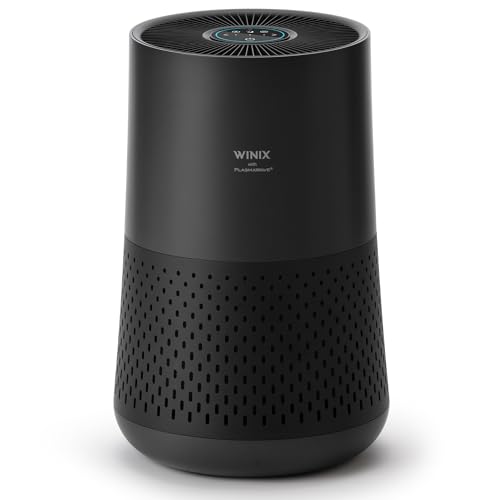
Quick verdict (one line)
Levoit Core 600S‑P — best when you need the highest airflow and stated coverage for extra‑large spaces; Winix A230 — best for bedrooms or medium rooms that benefit from built‑in air quality sensing, True HEPA filtration and an entry‑level price point.
Winner-by-use (40–60 words)
Winner-by-use: For extra‑large open areas or whole‑home turnover, Levoit’s Core 600S‑P wins because of its very high CADR (391 CFM) and stated coverage up to 2,933 sq ft. For bedrooms, medium rooms, or value‑focused buyers who want sensor‑led auto control and odor/VOC reduction, the Winix A230 is the practical pick.
Side‑by‑side specs
| Spec | Levoit — Core 600S‑P | Winix — A230 |
|---|---|---|
| Brand / Model | Levoit — Core 600S‑P | Winix — A230 |
| Listed coverage | 2,933 sq ft | 1,110 sq ft |
| CADR / airflow | 391 CFM (CADR) | Not listed |
| Filter type / efficiency | 3‑stage filtration; 99.97% efficiency for 0.1–0.3 μm particulates | True HEPA; captures 99.97% of airborne allergens as small as 0.03 microns; carbon filter for odors/VOCs (product title and features) |
| Smart / auto features | Auto Mode; AirSight Plus Technology (described as twice as accurate as an infrared laser) | Auto Mode; Air Quality Sensor (built‑in sensor measures and adjusts fan speed) |
| Other tech / features | VortexAir Technology 3.0; AHAM messaging & AHAM VERIFIDE reference in product copy | Reduces VOCs/household odors; designed to catch airborne particles and extend filter life; built‑in air quality monitoring adjusts fan speed |
What these differences mean in real rooms
Two numbers drive most buyer choices here: the listed coverage/CADR and the presence of sensors/active auto control.
Throughput and turnover: Levoit’s numbers
Levoit supplies a CADR of 391 CFM and a coverage claim of 2,933 sq ft. The product copy quantifies that as purifying 2,933 sq ft every hour, or 606 sq ft every 12.4 minutes. That combination—high CADR plus large coverage—indicates the Core 600S‑P is designed to move large volumes of air quickly. In practical terms, buyers who prioritize fast air exchanges in open plans, high‑ceiling living areas, basements, or multi‑room suites are the intended use case reflected in those numbers.
Sensors and targeted control: Winix’s approach
Winix lists coverage of 1,110 sq ft and breaks down throughput into smaller intervals (555 sq ft in 30 minutes, 370 sq ft in 20 minutes, etc.). The A230 includes a built‑in air quality sensor and an Auto Mode that measures and adjusts fan speed in real time. That sensor‑guided behavior makes the A230 better suited to bedrooms, medium rooms, or rooms where occupants want the unit to step up automatically when the sensor sees a change (cooking, pet activity, or transient smoke/odors).
Filtration nuance
Both products supply strong particulate capture claims but phrase them differently. Levoit’s maker’s listing states 99.97% filtration efficiency for 0.1–0.3 μm particulates as part of a 3‑stage system. Winix’s A230 is described as True HEPA capturing 99.97% of airborne allergens down to 0.03 microns and also calls out a carbon element for odors and VOCs. If your priority is formal odor/VOC reduction, Winix explicitly mentions odor/VOC reduction and a carbon filter in the title and feature list; Levoit’s description focuses on particulate capture and air‑movement technology (VortexAir).
Auto behavior and feedback
Levoit markets “AirSight Plus Technology” and notes that AirSight is twice as accurate as an infrared laser in its copy; it also supports Auto Mode and updates the display. Winix emphasizes a built‑in air quality sensor that measures and adjusts in real time. Both units therefore offer some form of automated fan control based on sensed air quality—but you should view them as different emphases: Levoit centers on air‑movement and a sensitive sensing suite; Winix centers on a practical sensor tied to automatic fan adjustment and odor control.
Choose one if/Choose the other if
Choose the Levoit Core 600S‑P if:
- You need maximum airflow and stated coverage—Levoit lists 391 CFM and coverage up to 2,933 sq ft, and advertises fast turnover for very large rooms.
- You’re cleaning large, open plans or multiple connected spaces and want a single unit that claims whole‑room/whole‑apartment throughput every hour.
- Air‑movement technology (VortexAir) and a high CADR are key purchase drivers for you.
Choose the Winix A230 if:
- You’re buying for bedrooms or medium rooms—the A230 lists 1,110 sq ft coverage and gives explicit smaller‑room turnover times (555 sq ft in 30 minutes, 370 sq ft in 20 minutes).
- You want a True HEPA filter and an explicit carbon/odor control element called out in the product title and features.
- You value an on‑board air quality sensor and Auto Mode that adjusts fan speed automatically to conditions, and you prefer a much lower entry price (check the current price on Amazon).
Concrete decision scenarios
Scenario: Open living/dining area, ~800–1,200 sq ft combined
Levoit—Supported. The Core 600S‑P’s high CADR and the product’s claim to purify hundreds to thousands of square feet per hour mean it’s positioned for larger contiguous spaces. Winix—Still usable, but the A230’s listed coverage (1,110 sq ft) and smaller turnover times mean it will work well but may operate at higher fan speeds more often if you expect very fast clearing after heavy contamination.
Scenario: Bedroom (150–300 sq ft)
Winix—Better fit. The A230 is described as a bedroom‑appropriate model with an air quality sensor and Auto Mode. Levoit—Capable, but Core 600S‑P is sized well above typical bedroom needs and may be over‑powered for very small rooms.
Scenario: Smoke or cooking odors
Winix—Has an explicit carbon filter mention and states it reduces VOCs and household odors. Levoit—Focused description on particulate filtration and air turnover; the maker’s listing does not explicitly mention a carbon filter for odor removal.
Scenario: Single unit to cover an entire apartment or small house
Levoit—Positioned for this use. The Core 600S‑P’s large coverage claim (2,933 sq ft) and 391 CFM CADR imply it’s designed to handle whole‑apartment airflow for larger footprints. Winix—May be appropriate for smaller apartments within the A230’s coverage range (up to 1,110 sq ft) but would be a smaller‑scale choice.
Known limitations and unanswered specs
Both product descriptions provide useful headline facts, but several ordinary buyer questions are not answered in the maker’s listings. Below are limits you should account for when comparing on‑paper specs to real use:
- Noise levels (dBA) are not listed for either model in the maker’s listings—so we cannot compare how loud each unit will be at different fan speeds.
- Energy use and power draw are not listed; total running cost comparisons require that data and typical daily runtime assumptions.
- Detailed filter composition and replacement intervals for each specific model are not listed. Levoit lists a three‑stage system and Winix lists True HEPA plus carbon, but neither maker’s listing gives recommended filter replacement intervals for these exact models.
- Winix CADR number: Not listed; Levoit CADR: 391 CFM.
- App connectivity, remote control methods, warranty lengths, and specific maintenance steps are not listed in the maker’s listings, so those features cannot be used to differentiate here.
How to use the listed coverage and turnover numbers
The manufacturers’ coverage and turnover claims are useful shorthand but require context. Two practical notes:
- Coverage is often stated as the area a unit can purify in one hour under specific test conditions. Levoit’s copy explicitly translates its CADR into hourly turnover (2,933 sq ft in 1 hour; 606 sq ft in ~12.4 minutes). Winix provides stepwise turnover times (555 sq ft in 30 minutes, 370 sq ft in 20 minutes, etc.). Use those numbers to estimate how quickly air might be exchanged in the room sizes you care about.
- Real‑world factors—ceiling height, open floor plans vs closed rooms, furniture that blocks airflow, doorways, and whether you keep windows open—will change actual performance. Higher stated CADR and coverage give you more headroom to deal with those real‑world inefficiencies.
Maintenance and running‑cost considerations (what to check before buying)
The maker’s listings include list prices and filtration claims but not ongoing costs for the Core 600S‑P or the A230. Before you buy, look up or confirm filter replacement cost, estimated annual running cost, and any warranty details.
- Official replacement filter part numbers and recommended replacement intervals for the exact model you plan to buy (these determine annual operating cost).
- Whether pre‑filters or carbon filters are sold separately and their unit costs.
- Typical filter lifetime claims from the manufacturer and any available genuine replacement filter listings for your exact model (our catalog includes Winix replacement filters for certain Winix models, but verify compatibility with the A230 before purchase).
Practical purchase guidance and next steps
If you’ve read this far and still have a central priority—turnover speed vs sensor‑led convenience—use these concrete prompts:
- If your home has large open spaces or you want the fewest number of units to circulate air across an entire apartment, favor the Levoit Core 600S‑P and its 391 CFM CADR and large coverage claim.
- If you want a lower‑cost unit with True HEPA filtration, explicit odor/VOC reduction, and a built‑in air quality sensor that drives Auto Mode for bedroom or single‑room use, favor the Winix A230.
- If you value both approaches, consider pairing: a high‑throughput unit where airflow matters most (living/dining), plus a sensor‑equipped unit in the bedroom for automated night‑time comfort. The maker’s listings position Levoit for high throughput and Winix for sensor‑based bedroom use.
Quick recap
Levoit Core 600S‑P: high CADR (391 CFM) and a very large stated coverage (2,933 sq ft) — best for large rooms and fast turnover. Winix A230: True HEPA with carbon odor control, built‑in air quality sensor and Auto Mode — best for bedrooms and medium rooms where sensor‑driven convenience and odor reduction matter.
Where to see each product (product pages)
View the Levoit Core 600S‑P details here: Levoit — Core 600S‑P
View the Winix A230 details here: Winix — A230
Further reading
For broader context on how brands differ or to compare more models, see our site pages: Air Purifier Comparisons, Best Air Purifiers by Room, Need and Budget, and Air Purifier Brands Compared.
Sources: Levoit vs Winix
To keep our Levoit vs Winix information accurate, we rely on independent references such as the EPA’s Guide to Air Cleaners in the Home, AHAM Verifide CADR data and manufacturer spec sheets. See how we evaluate air purifiers and our editorial policy for details.
