

Manfh
2026 Upgraded High Capacity Ozone Generator Odor Removal Up to 6000…
BrandManfhCoverage6,000 sq ft
Original price was: $46.99.$37.94Current price is: $37.94.
View product detailsProduct information comes from the current AirPurifierFAQ catalog and should be verified on Amazon before purchase.


In brief: Best Air Purifier for VOCs: our top air purifiers for VOCs, formaldehyde and chemical odors, ranked by verified CADR, noise (dB) and yearly filter cost.
This guide exists to solve a precise buyer problem: you need an air-cleaning solution that actually targets volatile organic compounds (VOCs) and chemical odors, not just dust and pollen. The recommendations below are restricted to the product set supplied for this article. Picks prioritize evidence of an activated‑carbon stage (or an explicitly carbon‑focused accessory), clear manufacturer position for odors/smoke, operational features that make gas‑phase filtration useful in practice, and safety: no endorsement of ozone for occupied spaces. Where vendors omit VOC‑specific performance (VOC CADR) or carbon‑bed mass, those gaps are flagged and explained so you can weigh risk vs. reward.
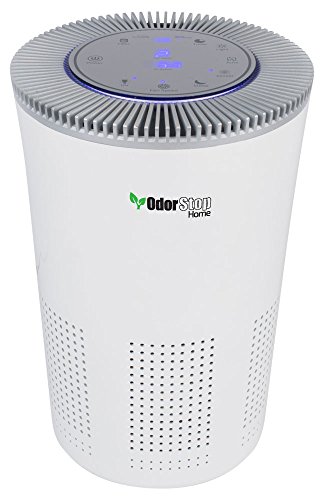
Best overall: OdorStop HEPA Air Purifier with H13 HEPA — it’s the strongest full‑unit candidate among the supplied products for smoke and odors because the manufacturer positions it for odor removal and includes H13 HEPA plus continuous/auto operation; pair it with a verified activated‑carbon replacement (or a carbon upgrade) for meaningful VOC removal. Many suppliers omit carbon bed mass and VOC CADR; ask before you buy.
“VOCs” are gas‑phase molecules — formaldehyde, benzene, toluene, acetic acid and thousands of others — produced by paints, cleaning products, building materials, some cooking, and many household materials. HEPA filtration (even H13) is excellent at removing particles: dust, pollen, smoke particulate, and so on. But HEPA fibers do not capture gases. To remove VOCs effectively you need a gas‑phase sorbent: most commonly activated carbon, sometimes impregnated carbon or other engineered adsorbents designed for specific chemicals.
That leads to two practical consequences when shopping:
We selected and prioritized models from the supplied product set using the following buyer‑focused criteria:
If a product page fails to publish VOC CADR, carbon bed mass (grams of activated carbon), or independent VOC test data, treat odor claims as qualitative. That doesn’t mean the product won’t help, but you should ask the manufacturer or seller for:
Prefer models that provide those numbers. If they aren’t available, prioritize devices with substantial carbon filters or compatible, well‑documented aftermarket carbon upgrades.
Role: Best full‑unit candidate among supplied products for smoke and odors.
Why it suits VOC/odor buyers: The manufacturer positions this model specifically for smoke and odors and supplies an H13 HEPA stage. It also offers practical controls — auto mode, sleep mode, 24‑hour timer and filter/air‑quality display — that make it easy to run the unit during periods of elevated emissions (cooking, painting off‑gassing, smoke events). Those features are important because continuous or prolonged operation is how gas adsorption is most effective in real environments.
What it does not say (important limitations): The product listing in the supplied data does not publish a carbon bed mass, VOC‑CADR, or a clear specification stating an activated‑carbon stage is included in the stock filter. HEPA is confirmed (H13), but HEPA alone will not remove VOCs. Before purchase, request confirmation: does this unit include activated carbon in the installed filter, and if so, how much?
Buying tip: If compatibility allows, plan to pair this unit with a verified carbon‑heavy replacement filter (for example, a compatible carbon kit) or add a dedicated carbon stage. If the manufacturer can’t confirm carbon mass, treat the OdorStop as a best‑practice HEPA platform for particle control and demand carbon data for VOC expectations.
Role: Best accessory / carbon upgrade candidate among the supplied products.
Why it fits: This replacement kit explicitly lists an activated‑carbon layer combined with H13 HEPA and a carbon pre‑filter. The vendor emphasizes increased carbon content and recommends annual replacement. For a compatible purifier, this kind of filter package is the simplest path to add meaningful gas‑phase sorbent without replacing the whole unit.
Limitations and checks: This is a replacement filter kit and not a standalone purifier — confirm compatibility with your specific purifier model before purchasing. Manufacturer data does not supply carbon‑bed mass in grams or independent VOC adsorption figures; price shown ($35.99 in the supplied data) is for the kit, not an annual cost estimate. The seller recommends replacement every 12 months, which is a reasonable starting point but real life depends on VOC load.
Buying tip: If you plan to use a purifier as a VOC solution, prefer replacement filters that specify carbon mass or that have independent VOC tests. If the MinusA2 kit fits your machine, it is a straightforward carbon upgrade for odor‑sensitive rooms.
Role: Best desktop HEPA option for particle‑heavy smoke and small rooms; co‑benefit for odors when combined with carbon.
Why it fits: It’s ENERGY STAR certified, rated by the vendor for up to 435 sq ft (based on 5 air changes per hour) and uses a 3‑stage HEPA filtration. For smoke particulate — wildfire smoke, cooking particles, secondhand smoke — this is a sensible room‑sized HEPA baseline. It has sleep mode and a filter life indicator, which encourages continued operation.
Limitations for VOCs: The supplied data does not indicate an activated‑carbon stage in the standard filter. HEPA will capture the particles but not the gas molecules. To address VOCs, you would need a compatible carbon pre‑filter or replacement that adds a substantive carbon bed.
Buying tip: If you have particle and gas concerns, buy a HEPA unit like this for particles and either add a carbon upgrade filter or pair with a small, targeted carbon device in the room. Check the vendor’s replacement‑filter options before purchase.
Role: Best budget/portable carbon‑focused option for very small spaces (desktop, dorm, travel).
Why it fits: This miniature unit explicitly uses activated carbon and ships with 10 replaceable carbon filters. For very small volumes — a personal desk, a car, a locker — it is a low‑cost, immediately deployable carbon option for reducing light odors and transient VOC spikes.
Limitations: Portable units have very limited carbon mass and therefore limited adsorption capacity. They can help in close‑proximity, low‑concentration situations but will not perform like a full‑size air cleaner with a large carbon bed. The supplied product data does not publish CADR or independent VOC metrics. Consider this an emergency or supplemental device rather than a whole‑room VOC solution.
Buying tip: Use mini carbon devices for point‑source odors (garbage bin, small cooking station, car). For sustained VOC sources (painting, new furniture), choose a larger unit with a documented carbon stage or ventilate/evacuate the space until off‑gassing subsides.
Role: Best quiet desktop HEPA for face‑to‑face use; co‑benefit when paired with carbon.
Why it fits: The supplied data lists H13 HEPA and a low noise figure (25 dB in sleep mode), plus a face‑to‑face air outlet that brings purified air directly to the breathing zone. For someone who wants particle removal with minimal sound while working or sleeping, this is a useful choice — and if you add a carbon element (replacement filter or adjunct carbon unit) it can become a localized VOC mitigation strategy.
Limitations: The manufacturer data does not report an activated‑carbon stage in stock filters. As with other HEPA desktops, the unit is not a gas‑phase solution by itself.
Buying tip: Use this at your bedside or desk for particulate control and pair with a small carbon device if you also have odor or VOC concerns at the same station.
Role: NOT a recommended routine VOC solution for occupied spaces. Included in the supplied set as an emergency deodorizer only.
Why it appears in this roundup: The seller markets it for fast deodorizing and lists enormous output and coverage (up to 6,000 sq ft in an unoccupied treatment). That makes it viable for certain commercial or renovation scenarios when used strictly in unoccupied spaces and when users follow specific safety procedures.
Crucial safety limitations: Ozone is a toxic oxidant at concentrations that remove odors. It is unsafe for people, pets and many plants at the concentrations required to treat significant odor or VOC loads. Manufacturer instructions in the supplied data explicitly state the machine must be used only in enclosed, unoccupied spaces and that doors and windows must be opened for 30–60 minutes of ventilation before re‑entry.
Buying tip and safe use checklist if you consider an ozone device:
Alternative: In nearly all household situations (occupied homes, bedrooms, kitchens, offices, schools), a properly sized activated‑carbon filter used continuously is safer and more appropriate.
From the supplied products, two clear categories emerge:
Trade‑offs to weigh:
Match the solution to the problem:
VOCs are often emitted from surfaces and furnishings. For best results:
Activated carbon becomes saturated. When that happens, it may stop adsorbing effectively and odors can reappear. Replacement frequency depends on pollutant concentrations; manufacturers sometimes recommend 6–12 months, but high VOC loads may require more frequent replacement. The supplied data notes the SomewayTop kit suggests annual replacement and the BLACK+DECKER filter is rated up to 2,000 hours — use those vendor guidelines as starting points, not hard rules.
If VOC concentrations are very high (strong, persistent chemical odors after renovation, solvent smells that cause symptoms, or suspected formaldehyde), ventilate immediately and consult professionals for measurement and remediation. Small consumer purifiers, especially those without documented carbon capacity, are not a substitute for targeted remediation of high‑load sources.
Answer these three questions to narrow choices from the supplied set:
If you answered “whole‑room” and “yes” to continuous runtime, prioritize a full‑size unit (OdorStop or BLACK+DECKER) and confirm carbon availability. If you answered “personal” or “point‑source,” a portable carbon unit (AuroraTurn) or a carbon replacement kit (SOMEWAYTOP) paired with a HEPA desktop may be the most practical combination.
The products provided for this guide include good HEPA platforms and some carbon accessories, but several important pieces of information are missing across the set:
Because of those gaps, the recommendations emphasize verified carbon stages (or accessory filters that add carbon) and operational features that make continuous use feasible. If VOC control is a high priority for you, insist on the data above from the vendor or choose a product line with published VOC performance and carbon‑bed specifications.
Smell is one indicator, but not a precise one. VOCs can be odorless or produce odors only at high concentrations. For a more objective read:
Because the best performance comes from combining particle and gas control, consider these practical pairings (based only on supplied products):
A: No. HEPA filters remove particles (dust, pollen, smoke particulate) but do not capture gas‑phase molecules like VOCs. To remove VOCs you need a gas‑phase sorbent — most commonly activated carbon — or a different engineered adsorbent designed for the specific chemicals of concern.
A: There’s no single gram‑figure that covers all situations because adsorption depends on the type of VOC, its concentration, airflow rate, and the carbon type/activation. As a rule of thumb, more carbon mass and slower airflow over the carbon increase capacity and contact time. If the vendor publishes carbon mass (grams) and independent VOC tests, use those numbers to compare models; otherwise, treat small portable carbon devices as only suitable for low loads or point‑source odor control.
A: Not for occupied spaces. Ozone can oxidize and thereby reduce certain odorous compounds, but the levels needed are harmful to people, pets and plants. The supplied Manfh model explicitly instructs use in unoccupied spaces and ventilation before re‑entry. For routine household use, choose a carbon‑based approach and ventilation rather than ozone. If you consider ozone for a specific, unoccupied remediation scenario, follow manufacturer warnings precisely and ventilate thoroughly after treatment.
A: Smell return is the most common indicator: persistent odors despite operation usually mean the carbon is saturated. Some manufacturers give recommended replacement intervals (the supplied SomewayTop kit recommends roughly 12 months; BLACK+DECKER lists a 2,000‑hour filter life for its HEPA), but actual life varies widely. If you need an objective measure, periodic VOC measurements with a handheld monitor provide the best data.
A: Sometimes. Check the manufacturer’s replacement filter options and compatibility. The SOMEWAYTOP kit is an example of a replacement package that adds carbon to a MinuA2‑style purifier. If a retrofit isn’t available, consider pairing a HEPA unit with a standalone carbon device in the same room.
A: Sizing for VOCs is more than room square footage: you need a balance of airflow (to bring polluted air to the carbon) and carbon bed mass/contact time (to adsorb gases). For an initial practical approach, use a HEPA unit sized for the room (based on manufacturer room coverage) and confirm it has a documented carbon stage or accepts a substantial carbon replacement. If the vendor supplies VOC CADR numbers, use those to compare devices directly.
For broader comparisons and deeper technical background, see our reviews hub and buying guides:
If you are shopping right now and VOCs or chemical odors are your priority:
Choosing an air purifier for VOCs requires more scrutiny than buying for dust and pollen. Demand carbon specifications or independent VOC tests, prioritize continuous‑run features that allow the unit to operate long enough to adsorb gases, and remember that ventilation and source control are often the fastest way to reduce indoor VOC concentrations. If you need help matching a specific room size, activity pattern or appliance to a model in the supplied list, use our reviews hub or the product pages linked above to check compatibility and replacement parts before you buy.
To keep our Best Air Purifier for VOCs information accurate, we rely on independent references such as the EPA’s indoor air quality resources, AHAM Verifide CADR data and manufacturer spec sheets. See how we evaluate air purifiers and our editorial policy for details.
Ask the manufacturer for: the activated‑carbon bed mass (grams), the carbon type (coconut shell, coal‑based, impregnated, etc.), any independent VOC adsorption tests or VOC CADR values, and clarity on whether the stock filter actually contains activated carbon. Those items let you move beyond qualitative "odor" claims.
No. H13 HEPA captures particles (dust, pollen, smoke particulates) but does not remove gases. The OdorStop listing confirms H13 HEPA and odor positioning but does not publish whether an activated‑carbon stage or carbon mass is included. Verify with the manufacturer whether the installed filter contains activated carbon and how much.
Because adsorption capacity is finite, continuous or long runtime is important. Use auto mode, sleep/low‑noise settings, and timers so the unit can run frequently or continuously during and after emission events (cooking, painting, smoke). Those features make gas‑phase filtration effective in practice by exposing VOCs to the sorbent over time.
Possibly — the SOMEWAYTOP kit explicitly lists an activated‑carbon layer with H13 HEPA, making it a strong carbon‑upgrade candidate. It is a replacement filter, not a standalone unit, so confirm compatibility with your specific purifier model before buying. Note: the vendor does not publish carbon‑bed mass, so ask for that if VOC capacity matters.
Yes — the page recommends asking about carbon type (standard coconut shell, coal‑based, impregnated, etc.) because different carbons and impregnations target different chemicals. If a product page omits that detail, request the carbon type and any VOC‑specific test data from the manufacturer before relying on the unit for chemical removal.
No. The guide does not endorse ozone for occupied spaces. If an ozone generator appears in the product set, treat it only as an emergency, unoccupied‑space tool; it is not a recommended household solution for VOCs or odors.
Answers are educational and may link to relevant guides or products on this site. Product facts can change, so confirm current details before purchase.
