

Manfh
2026 Upgraded High Capacity Ozone Generator Odor Removal Up to 6000…
BrandManfhCoverage6,000 sq ft
See today’s price on Amazon
View product detailsProduct information comes from the current AirPurifierFAQ catalog and should be verified on Amazon before purchase.



In brief: Best Air Purifier for Asthma: our top air purifiers for asthma triggers like smoke, dander and pollen, ranked by verified CADR, noise (dB) and yearly.
Ranked by our score from each maker's published specs. We earn a commission when you buy through our links, at no extra cost to you. Tap any button to see today's price on Amazon.

How this product scored 8.6 / 10
Based on the maker's specs as listed on Amazon. We don't lab-test every model. See how the score works.

How this product scored 8.6 / 10
Based on the maker's specs as listed on Amazon. We don't lab-test every model. See how the score works.

How this product scored 8.4 / 10
Based on the maker's specs as listed on Amazon. We don't lab-test every model. See how the score works.

How this product scored 8.4 / 10
Based on the maker's specs as listed on Amazon. We don't lab-test every model. See how the score works.

How this product scored 8.2 / 10
Based on the maker's specs as listed on Amazon. We don't lab-test every model. See how the score works.

How this product scored 8.1 / 10
Based on the maker's specs as listed on Amazon. We don't lab-test every model. See how the score works.

How this product scored 8.0 / 10
Based on the maker's specs as listed on Amazon. We don't lab-test every model. See how the score works.

How this product scored 7.9 / 10
Based on the maker's specs as listed on Amazon. We don't lab-test every model. See how the score works.

How this product scored 7.8 / 10
Based on the maker's specs as listed on Amazon. We don't lab-test every model. See how the score works.

How this product scored 7.5 / 10
Based on the maker's specs as listed on Amazon. We don't lab-test every model. See how the score works.
Top pick: Smart Air air purifier (8.6/10). True HEPA filter for fine dust, pollen and dander; covers rooms up to 900 sq ft; runs as quietly as 23 dB. It scores highest on this list, led by room fit and quiet operation.
Runner-up: Coway Airmega Halo (AP-1526D) (8.6/10, best for big rooms): HEPA filter for fine dust, pollen and dander. Also worth a look: Levoit air purifier (up to 222 sq ft) (8.4/10, best for odors): covers rooms up to 222 sq ft.
Scores come from published specs, certifications and brand track record, weighted for reducing asthma triggers in the air. See how we score.
This page is written for people with asthma (or caregivers) who need a practical, safety‑first buying plan: pick an air purifier that reliably reduces airborne particulate triggers without adding irritants (ozone or strong ion emissions), then match real product specifications to the room and use case where it will run every day.
The roundup uses only verified product specifications from our catalog. For asthma we prioritized the following:
Where a product lacked a specification we did not invent it — instead we flag the limitation so you can compare apples to apples.
Air purifiers can reduce the concentration of airborne particles that commonly trigger asthma symptoms: dust, pet dander, pollen and smoke particles. Where asthma is a concern, two safety requirements matter most:
Other useful elements include an activated-carbon stage for odors and VOCs (helpful during cooking or smoke events), clear filter life indicators and quiet sleep modes so the unit can run continuously.
What we can say from the manufacturer data: the OSAP5 uses an H13 HEPA filter (manufacturer states 99.97% capture at 0.3 microns), is rated for coverage up to 1,000 sq ft, and includes auto mode, sleep mode, 5‑speed motor, child lock, timer and a filter life/air quality display. The vendor also highlights a 24‑hour timer, three‑year warranty and a 30‑day money‑back policy.
Why it works for asthma: the H13 rating is the key advantage here, and the coverage figure makes it suitable for living rooms, open-plan areas or running in multiple rooms (but see the sizing guidance below). Auto mode and an air quality display help the device run at higher speeds only when needed, which improves long‑term comfort without excessive noise.
Limitations and facts to check before purchase: the maker’s listing does not include CADR numbers and filter replacement cost is not specified. Confirm filter pricing and replacement frequency on the product page before buying.
Key specs from the listing: H13 True HEPA filter, sleep mode and a manufacturer‑stated noise level of 25 dB in sleep mode. The QUEENTY desktop is designed to direct purified air toward the breathing zone with an oscillating outlet and includes an ionizer; the product listing also states “100% No‑Ozone” and standard safety certifications (FCC, CE, RoHS, WEEE).
Why it works for bedside use: low noise (25 dB) and H13 filtration let you run the unit all night without introducing ozone. The face‑level outlet design can be useful when you want purified air right where you sleep.
Limitations: the maker’s listing does not include a room coverage figure or CADR. This is a small/desktop unit meant for personal or near‑field use; it’s not a substitute for a larger whole‑room purifier.
Manufacturer claims: 3‑stage filtration with a HEPA stage that removes up to 99.97% of pollutants as small as 0.3 µm in rooms up to 435 sq ft (based on 5 air changes per hour), ENERGY STAR certified, sleep mode and a filter life indicator (filters last up to 2,000 hours per the listing).
Why it works for small bedrooms and offices: the declared coverage and 5 ACH basis give a clear performance expectation for small rooms. The long filter life and filter indicator are convenient for people who need low-effort maintenance.
Limitations: the listing does not provide a CADR number or a stated activated carbon stage; if odors or wildfire smoke are your biggest concerns, pair this with a carbon-capable option or verify the model’s carbon performance.
From the product data: HEPA + activated carbon filter, coverage quoted as 161 sq ft, low noise (below 30 dB) and USB power. The manufacturer recommends filter replacement every 3–6 months for optimal performance.
Why it’s useful: combines particulate removal with carbon for mild odors and VOCs in a very small footprint and at low cost. USB power makes placement flexible (desk, bedside, travel).
Limitations: this is a small‑room device; the coverage figure and low power mean it is suitable for near‑field or small rooms only, not whole living rooms. Yearly filter cost is not specified in our data.
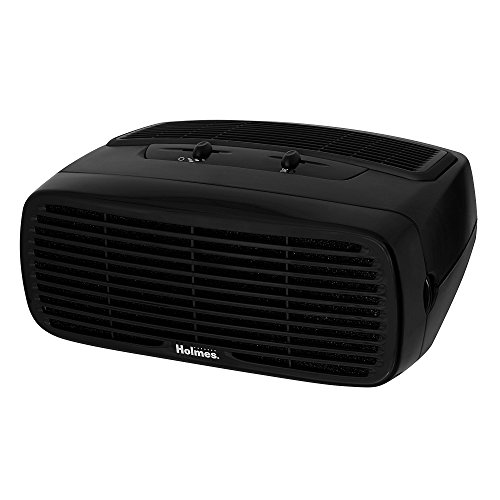
Manufacturer data highlights a 70 CADR rating, recommended coverage up to 109 sq ft and an optional ionizer. The listing describes capture of particles down to 2 microns and states the 70 CADR figure explicitly.
Why CADR matters: Clean Air Delivery Rate (CADR) is a standardized measure of a purifier’s effective airflow and is useful for sizing; the HOLMES unit gives you that metric so you can size more reliably for very small rooms or desks.
Limitations and caution: the listing calls the filter “HEPA‑Type” and specifies particle capture to 2 microns — this differs from H13 True HEPA performance for submicron particles. The device offers an optional ionizer; some ionizers produce ozone or secondary particles, so check the model details and avoid ionizer use if ozone is a concern.
Specification highlights: compact, USB powered, designed to capture cooking smoke and grease, washable/removable oil collection cup and washable filter. The listing emphasizes portability and dual-speed operation suited for short-term extraction near a cooking surface.
Where it fits: if you need a compact extractor for stovetop fumes during cooking events, this kind of device helps reduce immediate smoke and odor at source. For wildfire smoke or whole-room events you’ll want a full-room HEPA+carbon device instead.
Key facts: small plug‑in purifier with five replaceable carbon pads intended for desk, travel or very small shared spaces; marketed mainly for odor reduction and portable use. Listing notes the unit is not suitable for heavy smoke or medical use.
Why you might choose it: useful for travel, dorms or short-term odor control where low weight and portability matter. Not a replacement for a HEPA purifier for particulate removal in asthma management.
Manufacturer claims: very high ozone output, marketed to deodorize hard-to-remove odors; advertised coverage up to 6,000 sq ft and a timer/continuous operation option. The listing includes the manufacturer’s explicit safety note: “All ozone generators should be operated in an unoccupied space… people, animals, and plants must be kept away when the machine is working.”
Why to avoid: ozone is an irritant to the airways and is unsafe for people with asthma if used in occupied spaces. The device’s own labeling confirms it must not be used where people remain; it is not an appropriate choice for routine indoor air cleaning for people with asthma. We list it here only because it exists in the catalog and to flag it as unsuitable.
See product details (do not use for occupied spaces)
Start with the room where the purifier will run most of the time. Manufacturers typically list a square‑foot coverage. For more precise sizing, determine the room volume (sq ft × ceiling height) and target an air changes per hour (ACH) appropriate for your needs. A common practical approach:
To convert ACH to the CADR required (in cubic feet per minute, cfm): CADR (cfm) ≈ room volume (ft³) × ACH / 60. Example: a 12×12×8 ft bedroom is 1,152 ft³; to reach 4 ACH requires ≈ 1,152 × 4 / 60 ≈ 76 cfm CADR. (Not all products supply CADR — if CADR is missing, use the product’s stated square‑foot coverage as the vendor intended.)
For people with asthma prioritize a True HEPA stage (H13 where available). If odors, cooking fumes or VOCs are part of your concern, choose a model with an activated‑carbon stage in addition to HEPA.
If the unit will run overnight, choose models with a low sleep noise level or a documented low dB figure. QUEENTY lists 25 dB in sleep mode; frestar lists <30 dB. Lower noise increases the likelihood you’ll keep the purifier running, which is more important than occasional high-speed bursts.
Avoid ozone generators and be cautious about ionizers unless the manufacturer explicitly states “no ozone.” Some ionizers can create byproducts or ozone; HOLMES lists an optional ionizer — confirm whether it produces ozone and whether it can be switched off.
Choose a unit with high coverage and high‑efficiency filtration. From our list the OdorStop OSAP5 is the best single‑unit choice because of its H13 HEPA filter and 1,000 sq ft coverage claim. Verify CADR or consider multiple smaller units if you want better circulation in separate rooms.
Pick a low‑noise H13 bedside unit. The QUEENTY desktop unit reports 25 dB in sleep mode and uses H13 HEPA; it’s designed to deliver air directly to the breathing zone. For larger bedrooms, run a bigger H13 unit placed near the bed.
BLACK+DECKER’s tabletop HEPA has a clear coverage figure (435 sq ft) and long filter life, making it a solid choice for bedrooms, offices and small living areas where a dedicated unit is required.
For smell and VOC concerns pick a HEPA + carbon solution. The frestar desktop includes both HEPA and activated carbon and is a small, low‑cost carbon‑equipped option for small rooms. For heavy smoke (wildfire), run a full‑size H13/H14 HEPA unit with a substantial carbon stage — OdorStop cites smoke and cooking odors as within its use case, but verify carbon capacity if wildfire smoke is frequent.
Silanit’s mini rechargeable or frestar USB‑powered models are suitable for travel, dorms or near‑field workstations. Understand they are not whole‑room solutions for asthma management; they provide localized odor relief or near‑field particulate reduction.
All product statements are drawn from the maker’s listing. Several of the products do not provide CADR figures or yearly filter cost estimates; where data are missing we mark them as Not listed. This roundup does not incorporate independent laboratory testing; it is a buyer‑focused mapping of product claims to asthma‑specific needs.
If you want wider context about verification, independent tests and more models, see our broader reviews section and buying guides:
If you want a single sentence to guide the purchase:
An appropriately sized purifier with a True HEPA filter can lower airborne particulate concentrations (dust, pet dander, pollen, many smoke particles) in a room and therefore reduce exposure to common airborne triggers. It is not a medical treatment; continue to follow your medical plan and consult your clinician about environmental controls.
H13 HEPA indicates a higher filtration efficiency for submicron particles than “HEPA‑type” filters. For asthma, H13 or better is preferred because it targets very small particles that can reach the lower airways. “HEPA‑type” may perform less well for the smallest particles; check the product’s stated capture performance and consider H13 units where available.
Some ionizers are marketed to reduce airborne particles, but certain ionizers can produce ozone or secondary byproducts. If you have asthma, only use ionizing technology if the manufacturer explicitly states it produces no ozone and you can turn it off. Where possible, prefer mechanical filtration (HEPA) as the core technology.
Do not use ozone generators in occupied spaces. Ozone is an airway irritant and can worsen asthma. The Manfh ozone generator in our catalog is an example of a product that must only be used in unoccupied, ventilated spaces and is therefore inappropriate for routine use in homes with asthma.
Most people find sound levels below 30–35 dB comfortable for sleeping. If overnight operation is essential, prioritize a model that lists a sleep mode or specifies a dB figure in sleep mode (QUEENTY lists 25 dB; frestar lists <30 dB).
Replacement intervals vary by model and usage
To keep our Best Air Purifier for Asthma information accurate, we rely on independent references such as the EPA’s Guide to Air Cleaners in the Home, AHAM Verifide CADR data and manufacturer spec sheets. See how we evaluate air purifiers and our editorial policy for details.
Measure the room’s floor area and match it to the purifier’s stated coverage (square feet) or air changes per hour (ACH). For example, OdorStop lists coverage up to 1,000 sq ft and BLACK+DECKER lists performance assuming 5 ACH for 435 sq ft. If a product lacks coverage or CADR, verify CADR, ACH, or the manufacturer’s recommended room size on the maker’s listing before buying.
An ionizer can be acceptable only if the manufacturer explicitly states it produces no ozone. The QUEENTY desktop includes an ionizer and its listing states “100% No‑Ozone.” Avoid any device marketed as an ozone generator; confirm the maker’s ozone-emissions claim before using in occupied rooms.
Yes — activated carbon helps capture odors and many VOCs from cooking or wildfire smoke. We recommend carbon in addition to H13 HEPA when smells or VOCs are a concern. If the maker’s listing doesn’t state a carbon stage (as with some BLACK+DECKER variants), confirm the model’s carbon capability before purchase.
Check the maker’s listing for stated filter life and replacement indicators. BLACK+DECKER states filters last up to 2,000 hours and includes a filter-life indicator. If a listing does not specify replacement cost or frequency, confirm filter pricing and expected service life on the product page prior to buying.
Yes — running continuously is common for asthma management if the unit has a low-noise/sleep mode and does not generate ozone. QUEENTY’s listing shows a sleep mode at 25 dB and OdorStop lists sleep/auto modes for low-noise operation. Verify the unit’s sleep/noise specs and confirm no ozone production on the maker’s listing.
CADR is useful for comparing particulate removal speed, but you can also use stated coverage, ACH guidance, and the manufacturer’s specs. When CADR isn’t provided, confirm coverage and ACH on the maker’s listing and look for third‑party CADR test results or certifications to compare models.
Answers are educational and may link to relevant guides or products on this site. Product facts can change, so confirm current details before purchase.
