

Manfh
2026 Upgraded High Capacity Ozone Generator Odor Removal Up to 6000…
BrandManfhCoverage6,000 sq ft
Original price was: $46.99.$37.94Current price is: $37.94.
View product detailsProduct information comes from the current AirPurifierFAQ catalog and should be verified on Amazon before purchase.


In brief: Best Air Purifier for Mold: our top air purifiers for airborne mold spores and musty odors, ranked by verified CADR, noise (dB) and yearly filter cost.
Who this guide is for: readers who need an air purifier that will meaningfully reduce airborne mold spores in living spaces and want purchase-ready recommendations mapped to room size, noise tolerance, and budget.
What we selected: only units from our catalog that either use True HEPA (H13 or better) filtration or have an explicit function for odor remediation (ozone generators are included for completeness but not recommended for occupied spaces). Selections reflect real product data supplied by manufacturers; where a spec is missing we note that limitation and list the exact fact-checks editors should complete before any final buying widget is published.
Editorial angle: a buyer-first roundup that emphasizes capture efficiency against mold spores (HEPA/H13), correct sizing (CADR/ACH vs room volume), and the real-world trade-offs readers will face—noise, replacement-filter cost, and modes for continuous use. We do not rate products using tests that were not performed.
Verdict: Our top pick for most homes is the OdorStop OSAP5. It ships with an H13 True HEPA filter and is advertised for coverage up to 1,000 sq ft with Auto and Sleep modes that support continuous operation—important when you need ongoing spore removal in larger rooms or connected living spaces.
We grouped our choices to reflect the most common mold-related scenarios readers bring to us:
What the product facts say: OdorStop lists an H13 HEPA filter, coverage up to 1,000 sq ft, and features Auto Mode and Sleep Mode. The manufacturer emphasizes H13 filtration and a 3‑year warranty.
Why it fits mold-spore reduction: H13-rated filters meet higher filtration efficiency than consumer True HEPA (H11/H12) at very small particle sizes; that helps capture many airborne spores. The OSAP5’s Auto Mode helps the unit run continuously at the power necessary to maintain air quality, which is important because mold-spore removal improves with regular air changes over time.
Limitations and checks to perform before buying: OdorStop’s product sheet in our database does not list CADR (CFM) or noise figures. For sizing and expected cycles per hour (ACH) confirm CADR/CFM and the unit’s CADR for particles. Also confirm the price and model number for replacement H13 filters to calculate operating cost.
Buy link: OdorStop OSAP5 — product page
What the product facts say: BLACK+DECKER’s tabletop purifier is marketed for rooms up to 435 sq ft, uses a 3-stage HEPA system and claims to remove 99.97% of pollutants down to 0.3 microns at 5 air changes per hour. It’s ENERGY STAR certified and includes Sleep Mode and a child lock; filters last up to 2,000 hours per the manufacturer.
Why it fits mold-spore reduction: The unit’s 3-stage HEPA filtration and the manufacturer’s 0.3 micron claim indicate it targets particles in the size range of many spores. The provided coverage number gives a practical starting point for bedroom/medium-room users who want continuous overnight operation.
Limitations and checks: The CADR number and explicit dB figures are not supplied in our dataset—confirm CADR and noise to compare against other picks. Also validate the replacement filter SKU and price to estimate annual running cost.
Buy link: BLACK+DECKER Tabletop — product page
What the product facts say: QUEENTY ships with an H13 HEPA filter, claims a face-to-face air outlet and oscillation to direct flow to the breathing zone, and lists 25 dB operation in Sleep Mode. It’s USB-powered and designed for small spaces.
Why it fits mold-spore reduction: H13 filtration in a compact desktop unit is useful when the goal is to reduce the concentration of spores in the immediate breathing zone (desk, bedside). It’s not intended to treat an entire room; treat it as a supplement to room filtration.
Limitations and checks: No CADR is provided in our record, and the manufacturer’s small-room claims should be verified against a measured CADR or CFM if you need whole-room performance. Confirm replacement filter availability and cost.
Buy link: QUEENTY Desktop — product page
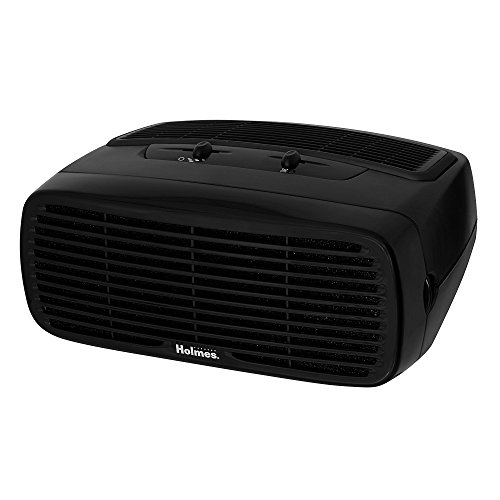
What the product facts say: Holmes lists a HEPA filter and a 70 CADR, recommends rooms up to 109 sq ft, and includes an optional ionizer. The product copy calls it a “HEPA-Type” purifier and states it captures particles as small as 2 microns and provides 70 CADR.
Why it fits mold-spore reduction: For small bedrooms or offices this can be a cost-effective way to reduce airborne spores in the space. The 70 CADR gives a concrete performance figure you can use to estimate ACH in a given room.
Limitations and checks: The “HEPA‑Type” language in the copy creates uncertainty about whether the filter meets a certified True HEPA standard. Our editorial recommendation is conditional: confirm with the manufacturer whether the filter is True HEPA (and, if so, which class), and confirm replacement filter cost.
Buy link: Holmes Desktop — product page
What the product facts say: Manfh advertises a high ozone output (up to 55,000 mg/hour), coverage up to 6,000 sq ft for odor treatment, and operating noise below 30 dB. The listing explicitly instructs that people, animals and plants must be kept away during operation and that the space must be ventilated for 30–60 minutes after treatment. It’s not available for sale in California.
Why it’s included: Ozone generators are sometimes suggested for mold odor or remediation of heavily contaminated, unoccupied spaces. We included the Manfh unit only to explain where ozone fits in the toolset and to warn readers of real safety limitations.
Important safety note: ozone is not a safe substitute for continuous filtration in occupied spaces. Do not run ozone generators in occupied rooms. If someone in the household has respiratory sensitivity, do not use ozone in the home at all. Use only in strictly controlled, unoccupied scenarios and ventilate fully after treatment.
Buy link: Manfh Ozone Generator — product page
Filtration is the practical approach to removing airborne mold spores in occupied spaces. There are three core concepts to understand when evaluating a purifier for mold:
True HEPA filters are particle filters designed to capture tiny particles. H13 and higher ratings refer to stricter laboratory standards and greater capture efficiency at smaller particle sizes. For airborne spores, an H13 filter gives stronger capture across the particle-size distribution commonly associated with fungal spores than lower-grade filters.
Watch out for marketing: “HEPA‑type” or “HEPA‑like” does not guarantee standardized capture efficiency. If the manufacturer uses “HEPA-type,” request the test standard or verification of particle-capture performance.
Two different numbers are important for sizing:
To estimate the CADR you need: compute room volume (square feet × ceiling height). Then use the formula CADR (CFM) = room volume × desired ACH / 60.
Example: For a 300 sq ft room with an 8 ft ceiling (volume = 2,400 cu ft) and a desired 4 ACH: CADR = 2,400 × 4 / 60 = 160 CFM.
If a product does not list CADR, ask the seller for CFM/CADR to apply that formula; lacking CADR, manufacturer “coverage” claims (e.g., “up to 1,000 sq ft”) are useful but less precise for predicting ACH.
Mold spores are constantly shed from colonized surfaces and introduced by open doors, windows, and HVAC systems. Continuous filtration—at a low noise setting if necessary—keeps airborne concentrations lower over time. Look for Auto Mode, timers, and sleep modes that make continuous operation tolerable overnight.
Use the short decision flow below to match a product to your needs.
If you want one device to service a large living/dining/kitchen area, prioritize a unit with an H13 filter and verified CADR sufficient to give multiple ACH for the combined volume. From our list, the OdorStop OSAP5 is positioned for up to 1,000 sq ft with an H13 filter; verify CADR/CFM to determine ACH for your ceiling height.
Noise matters. QUEENTY’s 25 dB sleep mode and BLACK+DECKER’s sleep mode and energy certification make them better picks for bedrooms—QUEENTY as a breathing-zone supplement (desk/bedside), BLACK+DECKER for whole-bedroom coverage up to its stated 435 sq ft.
Desktop H13 units such as QUEENTY offer directed flow and oscillation to create a cleaner micro-environment for the user’s face. These are not substitutes for room-sized units but are useful when a person spends long periods at a desk and wants extra reduction in their immediate breathing space.
Holmes’ 70 CADR and 109 sq ft recommendation make it a pragmatic choice for a small office or bedroom on a budget—so long as you confirm whether the “HEPA-type” filter meets the True HEPA standard you require.
Ozone generators such as the Manfh model are intended strictly for odor remediation in unoccupied spaces. If you have a musty odor linked to mold, consider professional remediation first. If an ozone treatment is considered, it should only be performed in an unoccupied house/room by someone who understands ventilation and exposure risks; never run ozone around people, pets or plants.
All five picks in this guide come from our verified product list. They represent three distinct approaches: high-efficiency room filtration (OdorStop), low-noise bedroom/desk filtration (BLACK+DECKER and QUEENTY), small-room/value capture (Holmes) and unoccupied odor remediation (Manfh ozone).
Before this guide is used as the final shopping tool, the following data points need confirmation from manufacturers or retailers (these are exact fact-check tasks):
Editors: collect these facts from manufacturer spec sheets or the retailer’s product pages and update CADR and replacement-filter cost fields in the table above.
Placement matters. For whole-room filtration place the unit off the floor, away from walls and with the intake and exhaust unobstructed. If the purifier has a 360-degree intake (some do), situate it centrally. For desktop units, orient the outlet toward the breathing zone but be aware they do not substitute for room filtration.
Maintenance basics: replace or clean pre-filters per the manufacturer, change HEPA/activated carbon filters on the recommended schedule, and keep the purifier’s vents dust-free. Dirty pre-filters reduce airflow and CADR, degrading performance against spores.
An air purifier reduces airborne spores but does not remove mold growth on surfaces or inside building structures. If you notice visible mold, persistent musty odors, or repeat contamination after filtration, consult a qualified remediation professional to find and remove the source. Air purifiers are a layer of control, not a remediation tool for active infestations.
HEPA filters capture particles by size and mechanism; higher-grade filters (H13 and better) have higher capture efficiency for the smallest particles. A True HEPA filter is preferable to “HEPA-type” or “HEPA-like” for consistent small‑particle capture. If mold is a serious concern, ask for the filter class (H13, H14, etc.) or a lab-standard test result.
There is no one-size-fits-all number because it depends on room use and contamination level. For general indoor air quality improvement, 2–4 ACH is common; for faster reduction in high-risk scenarios, target higher ACH. Calculate the CADR you need using room volume and desired ACH (CADR = volume × ACH / 60), then choose a purifier whose CADR meets or exceeds that number.
Ozone generators are not recommended for occupied spaces. The Manfh ozone generator in our catalog is explicitly intended for unoccupied odor remediation and must be used with strict safety procedures and ventilation afterward. Ozone is not a safe, continuous treatment for occupied homes and should not be substituted for filtration; for visible mold, professional remediation is the right first step.
Filter life varies by pollutant load and manufacturer guidance. Some units list filter lifetime in hours (e.g., 2,000 hours) or months; others give a change interval like 6–12 months. Confirm the specific replacement interval and SKU cost for the purifier you choose so you can budget annual operating expenses.
Coverage claims can be useful but are less precise than CADR or CFM when estimating ACH. If CADR is missing, ask the vendor for CADR or CFM so you can calculate ACH. If the vendor cannot provide CADR, use coverage numbers cautiously and consider selecting a unit with verified CADR for critical applications.
Continuous operation at a low fan speed is typically the most effective way to lower and maintain airborne concentrations of spores. Use Auto or Sleep Mode to keep the unit running without excessive noise. For intermittent heavy events (e.g., after disturbance or remediation), run at higher speed for a period to increase ACH, then return to a continuous low-speed setting.
For deeper spec comparisons, lab test methodology, and more buying scenarios see our related coverage: Air Purifier Reviews: In-Depth Research & Comparisons, Air Purifier FAQ: Every Question Answered, and the broader roundups at The Best Air Purifiers (2026). If you want guides targeted by room or need, explore Best Air Purifiers for Allergies (2026), Best Portable Air Purifiers (2026), and Best Desktop Air Purifiers (2026).
If you want a single, practical purchase for household mold-spore reduction, start with a True H13 HEPA unit whose CADR matches your room-volume target; for most homes in our catalog the OdorStop OSAP5 is the best fit but confirm CADR, noise and replacement filter cost before purchase. For bedrooms or desks prioritize low-noise units (QUEENTY or BLACK+DECKER), and remember that ozone generators are strictly for unoccupied odor remediation.
Editors: complete the fact‑check tasks listed above, add verified CADR and replacement-filter prices to the pick pages, and then link each pick to the retail/affiliate offer from the product pages in this guide.
To keep our Best Air Purifier for Mold information accurate, we rely on independent references such as the EPA’s mold resources, AHAM Verifide CADR data and manufacturer spec sheets. See how we evaluate air purifiers and our editorial policy for details.
Use the unit’s CADR (or CFM) together with your room volume to estimate air changes per hour (ACH); more ACH means faster reduction of airborne spores. Our picks note coverage areas, but where CADR is missing you should confirm the CADR/CFM from the manufacturer and then calculate expected ACH for your room before buying.
H13 is a rated HEPA class that the page says provides higher filtration efficiency than common consumer HEPA (H11/H12) at very small particle sizes. “HEPA‑Type” is ambiguous—our editors flag it as uncertain. If a product uses that term, verify with the manufacturer whether it is a certified True HEPA filter and which class it meets.
No. The guide includes an ozone generator only for odor remediation and explicitly says it is not recommended as a daily filtration solution for occupied spaces. If you’re considering one for odors, plan to use it only in unoccupied spaces and follow the manufacturer’s safety instructions.
The page lists H13 filtration, coverage up to 1,000 sq ft, Auto and Sleep modes, and a 3‑year warranty. Before buying, confirm the unit’s CADR/CFM (particle CADR), actual noise figures (dB), and the replacement H13 filter model number and price to estimate operating cost.
No. The editorial notes QUEENTY is intended as a breathing‑zone supplement (desk or bedside) with an H13 filter and 25 dB Sleep Mode. It’s not designed to treat an entire room. If you need whole‑room performance, request a measured CADR/CFM from the manufacturer and compare it to your room’s required ACH.
Continuous operation improves mold‑spore removal because regular air changes lower airborne concentrations over time. The guide highlights Auto and Sleep modes for continuous household use (notably on the OdorStop). Balance continuous use against noise, filter replacement frequency, and running cost—and confirm noise and filter costs for any model you consider.
Answers are educational and may link to relevant guides or products on this site. Product facts can change, so confirm current details before purchase.
