

In brief: Air Purifier vs Dehumidifier compared side by side: CADR, noise, filters, running costs and features, with a clear winner for each type of buyer.

Winner-by-use verdict
If airborne particles, smoke or odors are your primary concern in occupied living spaces, choose an air purifier — but the New Comfort BL3000 uses ozone/UV and is intended for unoccupied sanitizing runs, so it’s not suitable for continuous occupied-room use. For high humidity, condensation and mold risk, choose the AirCyan dehumidifier.
Side-by-side spec table: New Comfort BL3000 vs AirCyan 4500
| Specification | New Comfort BL3000 (Air Purifier) | AirCyan 4500 (Dehumidifier) |
|---|---|---|
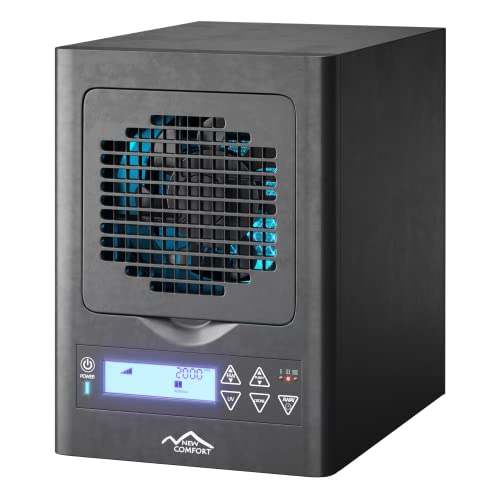
| Product type | Air purifier (ozone + HEPA + UV + photocatalytic + ionizer + charcoal) | Dehumidifier with integrated HEPA & carbon filters (2-in-1) |
| Brand | New Comfort | AIRCYAN |
| Price (listed) | Check the current price on Amazon. | Check the current price on Amazon. |
| Coverage / Room size | 3,000 sq ft (listed coverage) | 4500–5500 sq ft (flagship coverage stated) |
| Primary filter type | HEPA (washable HEPA also listed) | Dual H10 HEPA + carbon filters |
| Other technologies / features | 270 nm UV light; activated ozone generator (0–1,500 mg/h); TiO2 photocatalytic filter; negative ion filtration; 6 stages; 5 fan speeds; remote control | Smart Wi‑Fi, Alexa & Google Assistant, Sleep mode, ambient humidity lights, 360° wheels, continuous drain hose included |
| Noise | Not listed | 42 dB (Sleep Mode) |
| Energy / extraction performance | Not listed | Extracts up to 65 pints @ 95°F/95% RH (41 pints @ 86°F/80% RH); cited ~4.44 kWh daily energy use (Energy Star 2025) |
| Water handling | Not applicable | 0.79-gallon tank + 39″ drain hose for continuous drainage (included) |
| Best fit (as listed) | Whole home air purifiers / large spaces (but includes ozone/UV usage warnings) | Large spaces, basements, bedrooms; smart humidity control and sleep mode |
| Warnings / legal notes | Does not meet California requirements; cannot be shipped to California. WARNING: Use in unoccupied spaces only; ventilate after sanitizing; UV eye damage risk; California Prop 65 warning. | No California shipping restriction listed in the maker’s listing; general product safety features listed (sleep/eco modes). |
Choose A if / Choose B if
Short, practical guidance for the reader who wants the quickest decision:
- Choose the New Comfort BL3000 (air purifier) if your main problem is stubborn odors or surface-level sanitizing in unoccupied rooms, and you will only run ozone/UV sanitizing cycles when the space is empty and can be ventilated afterward.
- Choose the AirCyan 4500 (dehumidifier) if your primary issue is excess moisture — condensation, damp basements, mold/mildew risk, or protecting furniture and stored items — and you also want integrated HEPA/carbon filtration and smart controls for occupied-room use.
How each appliance works — what they treat and what they don’t
Air purifiers and dehumidifiers address different root causes. An air purifier circulates room air through filters and auxiliary technologies to remove or neutralize airborne particulates, some odors and, depending on the technology, biological contaminants. A true HEPA stage captures particles such as dust, pollen and many smoke particles. Activated carbon stages reduce many odors and VOCs, though effectiveness varies by pollutant and filter size.
The New Comfort BL3000 is a multi‑stage purifier: it lists a HEPA filter (washable HEPA noted), a 270 nm UV light, TiO2 photocatalytic stage, negative ion filtration, charcoal and an activated ozone generator adjustable from 0 to 1,500 mg/h. Those additional technologies are aimed at odor reduction and “sanitizing” cycles, but the manufacturer provides explicit use and shipping restrictions that affect where and how the unit should be used.
Dehumidifiers directly remove water vapor from air, lowering relative humidity. Dropping humidity is the correct control for condensation, damp fabrics, and the environmental conditions that allow mold, mildew and dust mites to multiply. The AirCyan 4500 lists extraction rates (65 pints @ 95°F/95% RH; 41 pints @ 86°F/80% RH), Energy Star 2025 “Most Efficient” energy figures (~4.44 kWh daily), a 0.79‑gallon tank plus a 39″ continuous drain hose, and integrated dual H10 HEPA and carbon filters. That combination makes it a two‑in‑one device: primary moisture control with secondary particulate/odor filtration.
Important operational difference: a dehumidifier’s main function is moisture removal. If the visible problem is fine airborne smoke (for example, persistent cigarette smoke in a living room used while occupied), a dehumidifier’s HEPA stage can help but may not be as effective as a dedicated purifier designed for continuous occupied‑room operation.
Known limitations and safety notes
- New Comfort BL3000 — ozone and UV restrictions: The maker’s listing states this unit “utilizes ozone technology” and includes a bold warning: “Use in unoccupied spaces only! Ventilate area after sanitizing.” The listing also states it “does not meet California requirements; cannot be shipped to California,” and includes a California Prop 65 exposure notice. The BL3000 also warns of UV eye damage risk. These are manufacturer statements; they make the BL3000 unsuitable as a continuous-use purifier in occupied rooms.
- Regulatory and safety context: Ozone-generating devices are sold for odor removal and sanitizing in some markets, but they carry clear operational limits. If you need an appliance for constant operation in bedrooms, living rooms or occupied offices, a unit explicitly designed and certified for occupied-room continuous use (no ozone) is normally the safer choice.
- Spec gaps matter: The BL3000 listing does not provide a CADR (clean air delivery rate) or noise level; those are useful metrics when comparing purifiers for occupied-room comfort and performance. If CADR or noise matters to you, request that information from the retailer or manufacturer before buying.
- AirCyan limitations: The AirCyan’s primary role is dehumidification. Although it lists dual H10 HEPA and carbon filters and therefore contributes to particle and odor reduction, the dehumidifier’s filtration section is secondary to removal of moisture. For continuous heavy smoke in occupied rooms, a dedicated HEPA purifier built for occupied use is still often preferable.
- Installation and logistics: The AirCyan supplies a drain hose for continuous drainage and a tank for intermittent emptying; the BL3000 has no water handling because it is not a moisture-control device. Also note the BL3000 cannot be shipped to California per its listing.
Decision scenarios — real rooms and problems
Scenario A — Allergies in a living room or bedroom
Situation: Frequent sneezing, visible dust and pet dander, bed/sleep quality affected.
Direct fix: A true HEPA air purifier designed for continuous operation in occupied rooms. For bedrooms and living rooms, noise and CADR matter: you want a unit specified for occupied‑space use and with verified noise figures.
How the two products compare here: The BL3000 lists a HEPA stage and claims particle capture down to 0.03 microns, but it also includes an ozone generator and the listing explicitly warns “Use in unoccupied spaces only.” That makes the BL3000 unsuitable for continuous bedroom or occupied living-room use unless you only run ozone cycles when people are away and then ventilate. The AirCyan lists dual H10 HEPA and carbon filters and has a quiet Sleep mode (42 dB); because it is intended for occupied rooms and includes filtration for particulates, it is a more appropriate everyday option for an occupied bedroom where humidity control is also desirable.
Scenario B — Damp basement with condensation and mold smell
Situation: Wet concrete walls, condensation on windows, musty odor; concern about mold on stored items.
Direct fix: Lowering relative humidity and continuous moisture removal. A dehumidifier is the direct tool for stopping condensation and changing the environment that supports mold growth.
How the two products compare here: The AirCyan 4500 lists extraction performance (up to 65 pints @ 95°F/95% RH; 41 pints @ 86°F/80% RH), covers large spaces (4500–5500 sq ft stated) and includes continuous drain capability via the included 39″ hose — features that match basement needs. It also offers HEPA and carbon filtration as a secondary benefit. The BL3000 does not remove moisture and therefore cannot address condensation or protect possessions from dampness.
Scenario C — Smoke or renovation odors
>
Situation: Strong odors after painting, cooking smoke, or lingering cigarette smoke that won’t clear with ventilation alone.
Direct fix: Odor removal can be difficult. Activated carbon and ventilation are primary tactics; in some cases short, controlled ozone or photocatalytic sanitizing runs are marketed as an option for odor removal in unoccupied spaces.
How the two products compare here: The BL3000 expressly markets its “POWERFUL OZONE GENERATOR” and photocatalytic filter for stubborn odors, and lists adjustable ozone output up to 1,500 mg/h plus a 270 nm UV stage. The listing includes the strong warning: “Use in unoccupied spaces only! Ventilate area after sanitizing.” That means you could use the BL3000 for a sealed, temporary odor-removal run when the room will be empty and you can ventilate afterward, but it’s not suitable for occupied use. For occupied spaces or continuous odor management, the AirCyan’s carbon filtration helps reduce odors during regular operation without ozone.
Scenario D — Mixed problem: damp basement with dust and intermittent smoke
Situation: Basement prone to dampness and mustiness, visible dust, occasional smoke from a nearby source or workshop.
Recommended approach: Start by addressing the root cause: humidity. The AirCyan 4500 is the logical first appliance because it removes moisture (and lists strong extraction performance) and provides integrated H10 HEPA + carbon filtration that will reduce dust and some odors while controlling humidity. If fine smoke particles persist despite the dehumidifier’s filtration, add a dedicated purifier designed for occupied-room continuous use (one without ozone) to target fine particulates and improve air turnover.
How to interpret the coverage, extraction and filtration claims
Coverage numbers and extraction rates mean different things depending on the appliance type. A purifier’s “coverage” expresses the maximum floor area the manufacturer estimates the unit can serve at a given ACH/CADR; a dehumidifier’s “coverage” usually reflects basement or whole‑house capacity under defined conditions and should be read alongside listed pints per day at specific temperature/RH points.
The maker’s listing lists coverage of 3,000 sq ft, which positions the BL3000 as a large-space purifier in marketing terms. However, the listing omits CADR and noise figures — two metrics that help translate coverage claims into real-world expectations for occupied rooms. The AirCyan listing supplies the environmental extraction numbers and a daily energy figure (4.44 kWh), both useful when sizing a dehumidifier for a particular room and estimating operating cost.
Practical checklist before you buy
- Identify the primary problem: Are you trying to remove water, particles, OR odors? Prioritize the tool that addresses the root cause — moisture → dehumidifier; airborne particles/continuous filtration → air purifier.
- If considering an ozone-capable purifier (BL3000), confirm how you will use it: only for short sanitizing cycles in unoccupied rooms with subsequent ventilation? If you need continuous occupied-room operation, choose a non-ozone purifier.
- Ask the seller for any missing specs that matter: CADR, noise levels across fan speeds (the BL3000 lacks listed noise), and filter replacement costs and intervals.
- For basement or whole-room moisture problems, check the dehumidifier’s extraction rates at realistic temperature/RH points and whether it has a continuous drain option — the AirCyan lists both extraction performance and a continuous drain hose.
- Consider controls and usability: the AirCyan lists smart Wi‑Fi, Alexa/Google compatibility and Sleep mode with a 42 dB sleep noise level — useful if the unit will run in living spaces or bedrooms.
- For long-term operating cost, compare energy use figures; the AirCyan provides a daily kWh estimate and an Energy Star 2025 Most Efficient claim.
- Check shipping and regulatory notes: the BL3000 listing explicitly states it “does not meet California requirements; cannot be shipped to California.”
When you might end up buying both
Some households have genuinely mixed problems: a damp basement that also has dust and occasional cooking or smoking smoke that drifts upstairs. In those cases the correct strategy is sequential: first control humidity (dehumidifier) to stop condensation and environmental mold risk; second, add or use a dedicated purifier for occupied rooms when particle capture or continuous odor control is needed. The AirCyan is designed to combine moisture control with filtration, which reduces the chance you’ll need both immediately — but if the particulate or odor load is high (for example, continuous indoor smoking), a dedicated purifier without ozone is still appropriate for occupied areas.
Where to read more and next steps
If you want deeper comparisons of purifiers built for occupied-room use, or to see lists of best devices by room and need, check our broader content: Best Air Purifiers by Room, Need and Budget and our general Air Purifier Comparisons section. If your house has an integrated HVAC and you’re weighing central filtration vs. portable devices, our Air Purifier vs HVAC Filter primer is helpful.
Soft recommendation
Use the root-problem rule: particles/continuous occupied-room filtration → pick a purifier designed for continuous occupied use (do not run ozone-capable units in occupied rooms). Excess humidity, condensation risk and wet basements → pick a dehumidifier; the AirCyan 4500’s extraction specs, continuous drain capability and smart controls make it well suited to damp basements and large spaces. For stubborn odors in unoccupied rooms only, the BL3000’s ozone/UV/photocatalytic combo may be applicable — but follow the product’s explicit warnings about unoccupied use, ventilation and California shipping restrictions.
For a curated selection of recommended models and options that match the needs described here, see our best-of guides at Best Air Purifiers by Room, Need and Budget.
Sources: Air Purifier vs Dehumidifier
To keep our Air Purifier vs Dehumidifier information accurate, we rely on independent references such as the EPA’s Guide to Air Cleaners in the Home, AHAM Verifide CADR data and manufacturer spec sheets. See how we evaluate air purifiers and our editorial policy for details.
