Rabbit Air
Rabbit Air A3 SPA-1000N HEPA Air Purifier, Toxin Absorber, Black
BrandRabbit AirCoverage1,070 sq ft
See today’s price on Amazon
View product detailsProduct information comes from the current AirPurifierFAQ catalog and should be verified on Amazon before purchase.


In brief: Best Air Purifier Under 100: our top air purifiers for strong performance for under $100, ranked by verified CADR, noise (dB) and yearly filter cost.
Ranked by our score from each maker's published specs. We earn a commission when you buy through our links, at no extra cost to you. Tap any button to see today's price on Amazon.

How this product scored 7.5 / 10
Based on the maker's specs as listed on Amazon. We don't lab-test every model. See how the score works.

How this product scored 7.2 / 10
Based on the maker's specs as listed on Amazon. We don't lab-test every model. See how the score works.

How this product scored 7.2 / 10
Based on the maker's specs as listed on Amazon. We don't lab-test every model. See how the score works.

How this product scored 7.1 / 10
Based on the maker's specs as listed on Amazon. We don't lab-test every model. See how the score works.

How this product scored 7.0 / 10
Based on the maker's specs as listed on Amazon. We don't lab-test every model. See how the score works.

How this product scored 6.9 / 10
Based on the maker's specs as listed on Amazon. We don't lab-test every model. See how the score works.

How this product scored 6.7 / 10
Based on the maker's specs as listed on Amazon. We don't lab-test every model. See how the score works.

How this product scored 6.7 / 10
Based on the maker's specs as listed on Amazon. We don't lab-test every model. See how the score works.
How this product scored 6.5 / 10
Based on the maker's specs as listed on Amazon. We don't lab-test every model. See how the score works.

How this product scored 6.2 / 10
Based on the maker's specs as listed on Amazon. We don't lab-test every model. See how the score works.
Who this guide is for: shoppers with a strict $100 limit who need a practical, low-cost air-cleaning device for a small bedroom, office, travel, or targeted odor-remediation tasks — and who want to understand the trade-offs that come with budget pricing.
What we considered: only models priced under $100 were eligible. We prioritized documented safety information (CARB listing, ozone notes), ongoing cost (filter replacements or lack thereof), and coverage/noise where the maker’s listing provided those figures. We did not invent CADR, noise, or room-size numbers when makers did not supply them; blank fields in the comparison table reflect missing data.
What you should expect reading this page: a quick verdict that names our single best pick under $100, a one-row comparison table for the models considered, short profiles explaining who each product suits best, clear safety cautions around ozone/ion/UV devices, and practical buying guidance that helps you decide whether to spend up to $100 or raise your budget for true‑HEPA performance.
Top pick: Azeus H13 (7.5/10). True HEPA filter for fine dust, pollen and dander; covers rooms up to 1,076 sq ft; runs as quietly as 24 dB. It scores highest on this list, led by room fit and quiet operation.
Runner-up: Vewior air purifier (up to 1,800 sq ft) (7.2/10, quietest pick): covers rooms up to 1,800 sq ft. Also worth a look: GoveeLife Smart Mini (7.2/10, best smart pick): covers rooms up to 376 sq ft.
Scores come from published specs, certifications and brand track record, weighted for budgets under $100. See how we score.
The table below reflects only data from the maker’s listings for the products considered. Empty cells indicate data the maker did not provide.
| Model | Type / Primary tech | Manufacturer-listed coverage (sq ft) | CADR (manufacturer-listed) | Noise (dB, manufacturer-listed) | Typical yearly filter / consumables $ | Affiliate link |
|---|---|---|---|---|---|---|
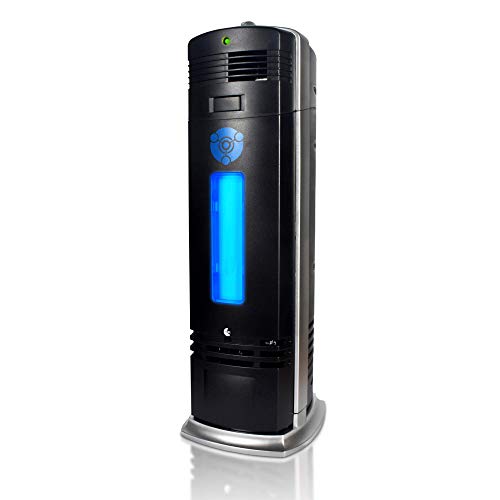
| OION Technologies B-1000 | Permanent filter / carbon + ionizer + UV (includes ozone listed ≤0.05 ppm) | Not listed | Not listed | Not listed (manufacturer describes “Whisper Quiet”) | $0 (no filter replacements; electricity only) | Buy / details (affiliate) |
| Manfh 2026 Upgraded High Capacity Ozone Generator | Ozone generator (O3) | 6,000 sq ft (manufacturer claim) | Not listed | <30 dB (manufacturer claim) | $0 (no filters; ventilation and safe‑use procedures required) | Buy / details (affiliate) |
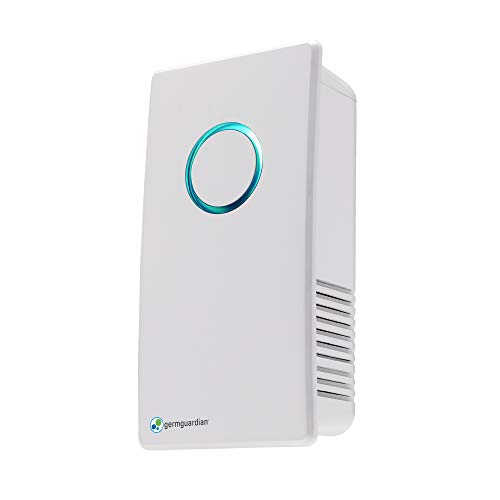
| GermGuardian GG1100W (7″ pluggable) | UV-C pluggable air sanitizer (Titanium Dioxide) | Small areas (pluggable device intended for bathrooms, kitchens, litter boxes) | Not listed | Not listed (passive device) | UV bulb replacement ~every 10–12 months (cost varies) | Buy / details (affiliate) |
Why it made the list: among the models reviewed the OION B-1000 offers the most balanced set of features for continuous use in an occupied room. It runs on very low power (the maker’s listing shows 7.5W), has a permanent internal filter so there are no recurrent filter purchases, and combines carbon filtration with negative‑ion output and UVGI. Importantly, the maker’s listing shows California Air Resources Board (CARB) certification and an EPA establishment number — both are relevant for buyers who want to confirm regulatory compliance around ozone emissions.
Who should choose this: budget‑minded buyers who want steady deodorization and low upkeep in a small bedroom, office, or hotel room. Because it needs no replacement filters the running cost is primarily electricity, making it inexpensive to operate over time.
Limitations: the manufacturer does not publish CADR or recommended square footage for whole‑room cleaning, so you should assume it is intended for small, localized zones rather than large living rooms. The B-1000 uses ion/UV and lists a small ozone contribution (manufacturer states O3 < 0.05 ppm) alongside carbon filtration — it is therefore not positioned as a substitute for a true HEPA purifier when the primary goal is removing fine particulates such as pollen, smoke particles, or pet dander.
Why it appears here: this unit is substantially cheaper than typical remediation-grade equipment and the manufacturer advertises high ozone output and very large coverage, which is why it is included among sub‑$100 devices. The product description emphasizes deep odor removal, rapid results, and a timer for unattended runs.
Who should choose this: homeowners, restoration crews, or vehicle owners who need a low‑cost device for short, aggressive deodorizing runs in unoccupied spaces — for example, to treat a closed basement, vehicle, or a room after heavy smoke or water damage. The manufacturer specifically states it must be used in enclosed, unoccupied spaces and that doors and windows should be opened for ventilation for 30–60 minutes before reoccupation.
Limitations and caveats: this is an ozone generator. Ozone has known respiratory hazards at elevated concentrations and should not be used in occupied spaces. The maker’s listing notes a sale restriction (not available for sale in California). Use requires strict adherence to the manufacturer’s safety instructions — if you cannot or will not follow them, do not use this device. The manufacturer’s coverage (up to 6,000 sq ft) and output figures are claims rather than independent test certifications; there is no CADR figure available.
Why it appears here: the GG1100W is a very low‑cost pluggable sanitizer intended for spot use: bathrooms, kitchens, pet rooms, or near a litter box where odors and microbes from surfaces can accumulate. It’s compact and needs no filter replacements; it does require a UV bulb swap every ~10–12 months depending on use.
Who should choose this: people who want a tiny, low‑maintenance device for a specific spot where odors or bacteria are a problem and who understand its limited scope. It is not designed to clean the air of an entire bedroom or living room; it treats a very local volume of air and surfaces around the outlet.
Limitations: the manufacturer lists germ‑control claims tied to UV‑C and titanium dioxide, but there is no CADR or room‑size rating provided for whole‑room particle removal. UV bulbs are a consumable; bulb replacement costs vary by seller.
Setting realistic expectations will save disappointment. At this price you should expect one or more of the following:
Budget units commonly rely on ionizers, UV light, and in some cases ozone to reduce odors or microbes. Each technology has practical benefits and specific safety considerations:
What they do: ozone (O3) oxidizes many odor molecules and can alter the chemistry of surfaces and airborne compounds. Why that matters: ozone at elevated concentration is an irritant; prolonged exposure is unsafe. Manufacturer instructions for the Manfh model explicitly require operation only in unoccupied, enclosed spaces and a ventilation period before re‑entry. The product page also notes it cannot be sold in California — a regulatory signal that buyers should treat ozone devices with caution.
Practical rule: do not use ozone generators in occupied rooms. Limit use to targeted, short runs in unoccupied spaces and ventilate thoroughly before people, pets, or plants return.
What they do: ionizers emit charged particles that cause airborne particles to aggregate and fall out of the breathing zone or to adhere to surfaces. Many budget hybrid units pair ion output with carbon filtration and UV. The OION B‑1000 lists both ion output and UVGI plus carbon media, and the manufacturer states a very low ozone emission (≤0.05 ppm) and CARB certification.
Practical rule: ion/ion + carbon hybrids can reduce odors and some particulates in small areas. If you or household members have significant particulate‑sensitivity (e.g., heavy allergy symptoms), a certified true‑HEPA mechanical filter is a safer choice for particle removal.
What they do: UV‑C light can inactivate certain microbes on surfaces and in air streams when configured properly. Pluggable sanitizers are intended for very small localized areas; the GG1100W requires bulb replacement about every 10–12 months.
Practical rule: UV devices can supplement other hygiene measures, but a tiny pluggable UV sanitizer is not a full-room air cleaner. Consider them for spot treatment, not whole-room particle removal.
Upfront price is only part of lifetime cost. Below are the principal ongoing expenses to consider for these models.
Follow this short decision checklist to match product to need.
You should raise your budget above $100 if any of the following apply:
For detailed product reviews and comparison testing of higher‑tier models, consult our broader review hub: Air Purifier Reviews: In‑Depth Research & Comparisons, and our room‑and‑need buying guide collection: Best Air Purifiers by Room, Need and Budget.
This roundup is a buyer’s distillation of product data for items under the $100 threshold. We did not:
Small devices can be effective when used correctly — pay attention to placement and habits:
No. Among the under‑$100 devices we looked at there are no mainstream true‑HEPA whole‑room purifiers. The OION B‑1000, Manfh ozone generator, and GermGuardian GG1100W use combinations of carbon, ionization, ozone, and UV; these technologies can help with odors and some microbes in small or targeted settings, but they are not equivalent to mechanical True HEPA filtration for removing fine particulates across a whole room.
The OION product listing includes CARB certification and states ozone emissions of <0.05 ppm; those are useful compliance signals. It also advertises low power use and no filter replacements. If you intend continuous use in occupied spaces, follow the manufacturer’s instructions and monitor for any odors or irritation. If you have any doubt about sensitivity to ozone or ions, consider a mechanical HEPA model with documented particle filtration instead.
No. The manufacturer explicitly states it must be used only in enclosed, unoccupied spaces and that people, animals, and plants must be kept away when the machine is running. Ventilate the area for 30–60 minutes after a treatment before reoccupation. Do not use ozone generators for routine continuous air cleaning in occupied spaces.
For these models: the OION B‑1000 advertises no replacement filters (permanent filter) so recurring filter costs are effectively zero; the GermGuardian GG1100W needs a UV bulb replacement roughly every 10–12 months depending on runtime; the Manfh ozone generator has no filters. Always check the product page or user manual for exact part numbers and recommended replacement intervals.
If allergies are your primary concern, none of these three devices should be regarded as the optimal solution. Mechanical True HEPA filtration with a stated CADR and room‑sizing guidance is the recommended approach for particle removal. For allergy‑focused recommendations, see our guide: Best Air Purifiers for Allergies (2026).
Our short next steps: consider raising your budget into the $100–$200 band where you can find compact True HEPA models with published CADR and room coverage. See our sibling roundup: Best Air Purifiers Under $200 (2026), and consult our full reviews hub for in‑depth comparisons: Air Purifier Reviews.
Under $100, you can buy low‑maintenance odor control and tiny spot sanitizers, or a low‑cost ozone unit intended for unoccupied remediation runs — but you should not expect certified whole‑room HEPA particle removal. Among those reviewed, the OION B‑1000 is the best single value for continuous small‑room odor reduction and minimal upkeep; use an ozone generator only in strict unoccupied scenarios; and treat pluggable UV devices as spot‑treatment tools, not full‑room solutions.
If you need verified particulate removal for allergy relief, smoke, or a large room, plan to expand your budget and consult our guides linked above. For product technical pages and to purchase the models discussed here, follow the links in the comparison table.
To keep our Best Air Purifier Under 100 information accurate, we rely on independent references such as the EPA’s Guide to Air Cleaners in the Home, AHAM Verifide CADR data and manufacturer spec sheets. See how we evaluate air purifiers and our editorial policy for details.
The maker's listing shows CARB certification and an EPA establishment number; the manufacturer also states an ozone output.
No. The B-1000 uses carbon filtration, ion output, and UVGI and does not publish CADR or room-size ratings. The guide notes it is not a substitute for a true HEPA whole‑room purifier for allergy control.
Units marketed for aggressive deodorizing are intended for short runs in unoccupied spaces. The guide advises these units are for unoccupied use only, require ventilation and safe‑use procedures, and should not be run in occupied rooms; verify manufacturer safety instructions and local regulations before use.
Costs vary by technology: some plug‑in models have permanent filters and no filter-replacement cost (electricity is the primary running cost); ozone generators typically have no filter cost but need ventilation precautions; some units with UV require bulb replacement about every 10–12 months. Check the product listing for replacement frequency and current prices.
Check the maker's product listing for CARB registration and any EPA establishment number, or search CARB/public registries for the model. If details aren’t present, ask the manufacturer directly. Don’t rely on unlabeled marketing claims.
None of the models covered are mainstream true‑HEPA whole‑room purifiers. For HEPA‑grade whole‑room performance the guide recommends a higher budget.
Answers are educational and may link to relevant guides or products on this site. Product facts can change, so confirm current details before purchase.