

Manfh
2026 Upgraded High Capacity Ozone Generator Odor Removal Up to 6000…
BrandManfhCoverage6,000 sq ft
Original price was: $46.99.$37.94Current price is: $37.94.
View product details
Product information comes from the current AirPurifierFAQ catalog and should be verified on Amazon before purchase.




This roundup is written for people who cook at home and want kitchen air that doesn’t smell like last night’s dinner: apartment cooks, open-plan families, and anyone trying to reduce frying smoke, charred food fumes or lingering food odors. The picks below use only products supplied to AirPurifierFAQ and match recommended filtration approaches (true HEPA + activated carbon or focused source-capture units) to cooking style and kitchen size. If you need HVAC integration, professional ventilation, or laboratory-grade testing, check our linked reviews and buying guide for next-level detail.
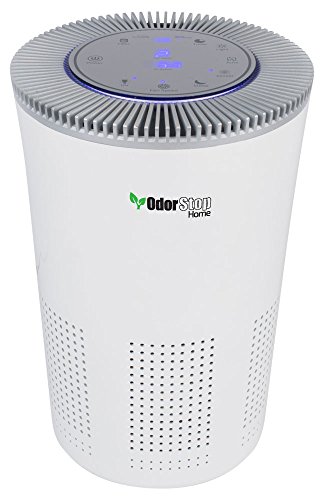
Best overall: OdorStop OSAP5 — a H13 True HEPA purifier paired with activated carbon, 360° intake and auto/sleep modes; it’s designed for open-plan and larger kitchens where you need particle removal and sustained odor adsorption with hands-off operation.
Why it’s here: the OSAP5 pairs a manufacturer-stated H13 True HEPA filter with active carbon and a 360° intake, plus five fan speeds, auto and sleep modes. These features make it a sensible whole-room option for open-plan kitchens where frying and grilling disperse smoke and odors across the living space. Manufacturer lists coverage of 1,000 sq ft and highlights the H13 rating for 0.3-micron capture.
Ideal for: open-plan apartments or houses where the kitchen flows into a living area and you need continuous particle removal plus odor adsorption without constant user intervention.
What to watch for: OdorStop’s page lists many convenience features but does not publish CADR or steady-state noise in the supplied product facts; if noise or measured CADR matters for your space, check the in-depth review or customer Q&A before buying. Also confirm replacement filter SKUs and cost if you’ll run the unit heavily during daily cooking.
Why it’s here: essentially a sibling model in OdorStop’s H13 lineup, this purifier emphasizes H13 particle capture plus active carbon and smart modes (auto/sleep) for hands-off operation. Manufacturer copy highlights a 360° intake and filter-life/air-quality displays, which help when cooking intensity varies across the week.
Ideal for: kitchens that don’t require the OSAP5’s 1,000 sq ft claim but still benefit from H13-level filtration and automated control. Good where a lightweight, feature-rich unit is desirable.
What to watch for: coverage and CADR are not supplied in the product data here; verify the stated room-size claim in the full product details. Replacement filter availability and price are not given — confirm before purchase if you’ll run the unit daily during heavy cooking.
Why it’s here: BLACK+DECKER’s tabletop unit lists a three-stage HEPA system and manufacturer-stated coverage up to 435 sq ft (based on 5 air changes per hour). It’s compact, ENERGY STAR–certified, and includes sleep mode — useful for small studios and condos where a countertop placement near a cooktop can help with light-to-moderate cooking smells.
Ideal for: studio apartments, small kitchens, or as a near-cooktop assistant where you want a low-profile unit that still claims significant coverage. The stated filter life is up to 2,000 hours, which helps estimate replacements.
What to watch for: CADR and dB are not stated on the supplied page; BLACK+DECKER lists the filter life but not the replacement filter price. If you cook heavy-frying meals frequently, a countertop unit will help but won’t perform as well as a source-capture extractor or a larger HEPA+carbon unit for strong, persistent odors.
Why it’s here: this small desktop fan is designed for source capture — it tilts (15° adjustable) to point at rising fumes, has a removable oil cup for grease collection, and a washable filter. It runs on USB power and advertises quiet dual-speed operation. These design choices make it better at catching visible smoke and grease near the stove than a remote room purifier.
Ideal for: small kitchens, RVs, hot-pot nights, or casual grilling indoors where localized suction and an oil cup reduce greasy residue and visible smoke before it disperses.
What to watch for: manufacturer materials describe it as a smoke-and-odor helper for indoor cooking and smoking, but there’s no CADR or stated room coverage. The washable filter and oil cup reduce ongoing filter spend, but the unit is limited in scope — it won’t replace a hood or a full-room HEPA+carbon system for widespread odor control.
Why they’re here: these tiny units (some rechargeable, some plug-in) use activated carbon pads and claim portability, quiet operation and multiple replaceable carbon filters. They’re suited to desks, small counters and RVs and can reduce light cooking smells and smoke at very close range.
Ideal for: single-cooktop use in tiny spaces, dorm rooms, or as a short-range odor reduction tool when you can place the unit within a few feet of the source.
What to watch for: all of these minis are explicitly described as not suitable for heavy smoke or medical use. Their carbon pads are inexpensive but require frequent replacement or air-drying. If you do frequent high-heat frying, they won’t be sufficient to protect the whole kitchen.
Buy on Amazon — Silanit (5 carbon pads)
Buy on Amazon — AuroraTurn (10 carbon pads)
Buy on Amazon — ormos
Why it’s listed: this device is present among supplied products and the manufacturer emphasizes rapid odor removal via ozone. It claims coverage up to 6,000 sq ft and fast deodorizing power. That said, the product itself and the manufacturer copy explicitly warn that ozone generators must be used only in unoccupied, ventilated spaces and are not available in California.
Our position: ozone generators are not appropriate for routine use in occupied kitchens. Manufacturer instructions require you to leave the space while the device runs and ventilate afterward — largely eliminating the practicality of in-use cooking odor control. We recommend other picks for occupied spaces.
Cooking creates two broad air-quality problems: particulate smoke (PM2.5 and larger) and odorous volatile compounds (VOCs). The right approach depends on where the odors originate, how often you cook, and how strong the fumes are.
Use the manufacturer’s stated coverage as a starting point but match to the combined kitchen + living area if your space is open plan. For a quick rule-of-thumb: place a source-capture unit within 1–3 feet of the stove; place a whole-room purifier near the kitchen’s dominant airflow path (not tucked low behind cabinets). If you have two cooking zones (island + wall), consider a medium purifier centrally or two smaller units for targeted coverage.
Cooking-heavy use increases filter loading. Expect more frequent filter changes or cleaning when you cook often, especially with frying or oil-heavy meals.
HEPA removes particles (soot and smoke particulate), but odors come from VOCs and other gases that require adsorption. Activated carbon or other sorbents are the only practical household-stage technology for removing many odorous molecules. For kitchen odor control look for units that explicitly include an activated-carbon stage or a replaceable carbon pad. Manufacturer claims of “odor removal” generally refer to a carbon-based stage; check bed quantity and replacement frequency where possible.
Source-capture devices and mechanical range hoods remove grease and smoke at the point of generation and are more effective for heavy frying, wok cooking and grilling. A purifier located away from the stove will have to wait for fumes to disperse through the room before it can clean them. If you cannot install or use a hood, a focused desktop extractor directly beside the cooktop is the next best option; pair it with a whole-room purifier for distributed odors.
We used only product information supplied to AirPurifierFAQ and did not conduct independent CADR or noise testing. Several supplied product pages do not publish CADR, steady-state dB, or explicit replacement filter prices; where those data are missing we either mark them as such or advise you to consult the product review page for measured performance. We also did not include products not present in the provided dataset, so this roundup focuses on the supplied, purchase-ready models and their stated features.
For deeper testing methodology and head-to-head comparisons, see our reviews hub: Air Purifier Reviews: In-Depth Research & Comparisons. For broader buying guidance and room-based recommendations, see The Best Air Purifiers (2026) and the category overview at Best Air Purifiers by Room, Need and Budget. Our general FAQ on air purifier basics is at Air Purifier FAQ: Every Question Answered.
Recommendation: BLACK+DECKER Tabletop or a Silanit/AuroraTurn mini on the countertop. These units handle light-to-moderate cooking smells quickly at short range and have small footprints. Expect to run them on medium-high while frying, and clean washable parts or replace pads per the manufacturer’s guidance.
Recommendation: OdorStop OSAP5 as the primary whole-room purifier plus a small desktop extractor on the cooktop if a range hood is inadequate. The OSAP5’s H13 HEPA removes particles while its activated carbon helps with lingering odors; the source-capture unit reduces grease deposition on the purifier’s prefilter.
Recommendation: a portable source-capture unit like the Silanit Desktop Smoke Purifier Fan positioned close to the stove during cooking, and then run the OdorStop (or similar H13+carbon unit) after cooking to clear dispersed particles and odors from the rest of the room.
Short answer: It depends. HEPA filters remove particles but not gases; activated carbon is needed to adsorb many odorous VOCs. For heavy frying or greasy smoke, combine a source-capture extractor or hood with a HEPA + activated-carbon purifier. Small or portable carbon-only units will help short-range but won’t clear an entire open-plan area quickly.
No. The manufacturer information for ozone devices (for example, the Manfh model in this roundup) requires the space to be unoccupied while the device runs and ventilated after — making them impractical and unsafe for routine occupied-kitchen use. We do not recommend ozone devices for spaces where people and pets are present.
As close as practical — within 1–3 feet of the stovetop is typical. The goal is to intercept rising smoke and grease before it spreads. Position the unit so the exhaust path from stove to extractor is unobstructed and empty the oil cup or clean the washable filter regularly.
Filter life varies by model and cooking load. BLACK+DECKER lists about 2,000 hours for its filters, but heavy frying and oil exposure reduce service life. Washable prefilters and oil cups reduce frequency. For non-washable carbon and HEPA filters, expect more frequent replacements under heavy use; verify replacement filter pricing before you buy.
Not really. Minis are useful for highly localized odor reduction but lack the airflow and carbon bed to treat an entire open-plan area effectively. For open-plan kitchens, use a full-sized HEPA + carbon purifier like the OdorStop OSAP5 and consider a dedicated extractor at the stove for the best results.
Request CADR (clean-air delivery rate) for smoke and particles when available, steady-state dB levels for noise expectations, and manufacturer guidance on room coverage. Also confirm filter types and replacement part numbers so you can check ongoing costs.
1) Decide whether you need source capture (stovetop-focused) or whole-room coverage (open-plan). 2) Prioritize H13/HEPA + activated carbon for combined particle and odor control. 3) Check manufacturer-stated coverage, washable parts and filter replacement options. 4) If you’re considering an ozone machine, reconsider — they’re for unoccupied use only and not practical for everyday cooking odor control.
To compare options and read longer-form tests and buying guidance, see our reviews hub and the category overview at The Best Air Purifiers (2026).
For source-capture extractors, place the unit as close to the stove as feasible to catch grease and visible smoke. For whole-room HEPA+carbon purifiers, place them centrally or on the cook-side of the open-plan area so airflow moves fumes toward the intake. Positioning depends on layout and unit type.
No. Devices that intentionally produce ozone are not appropriate for occupied kitchens. The manufacturer notes that ozone units must be used only in unoccupied spaces, and this guide flags them as “do not use while cooking or while people are present.” Verify any ozone-related warnings before use.
A tabletop purifier can be useful in small studios or condos: BLACK+DECKER’s unit claims coverage up to 435 sq ft (based on 5 ACH), is ENERGY STAR certified, and lists a filter life up to 2,000 hours. It helps with light-to-moderate smells but won’t match source-capture extractors or larger HEPA+carbon units for heavy frying or persistent odors.
For heavy frying or visible smoke, a source-capture extractor that sits near the stove is generally more effective at removing grease and rising fumes before they disperse. Whole-room HEPA+carbon purifiers are better when fumes spread across an open-plan area or you need continuous particle and odor removal throughout the space. Choose based on cooking style and room layout.
Kitchen use typically increases maintenance: expect more frequent cleaning of washable parts or emptying removable oil cups on source-capture units, and more frequent filter replacements on HEPA+carbon units. The guide prioritizes units with washable parts and clear filter-life information—verify replacement filter SKUs and costs if you plan heavy daily cooking.
Check the in-depth review or the product Q&A for measured CADR and steady-state noise if those metrics matter for your space. Also confirm replacement filter SKUs, availability, and cost, plus any long-term operating notes for heavy daily cooking. The page flags these data as not supplied in the basic product facts.
Answers are educational and may link to relevant guides or products on this site. Product facts can change, so confirm current details before purchase.
