Manfh
2026 Upgraded High Capacity Ozone Generator Odor Removal Up to 6000…
BrandManfhCoverage6,000 sq ft
See today’s price on Amazon
View product detailsProduct information comes from the current AirPurifierFAQ catalog and should be verified on Amazon before purchase.




In brief: Best Cheap Air Purifier: our top air purifiers for tight budgets without junk filters, ranked by verified CADR, noise (dB) and yearly filter cost.
Ranked by our score from each maker's published specs. We earn a commission when you buy through our links, at no extra cost to you. Tap any button to see today's price on Amazon.

How this product scored 7.5 / 10
Based on the maker's specs as listed on Amazon. We don't lab-test every model. See how the score works.

How this product scored 7.2 / 10
Based on the maker's specs as listed on Amazon. We don't lab-test every model. See how the score works.

How this product scored 7.2 / 10
Based on the maker's specs as listed on Amazon. We don't lab-test every model. See how the score works.

How this product scored 7.1 / 10
Based on the maker's specs as listed on Amazon. We don't lab-test every model. See how the score works.
How this product scored 7.0 / 10
Based on the maker's specs as listed on Amazon. We don't lab-test every model. See how the score works.

How this product scored 6.9 / 10
Based on the maker's specs as listed on Amazon. We don't lab-test every model. See how the score works.

How this product scored 6.7 / 10
Based on the maker's specs as listed on Amazon. We don't lab-test every model. See how the score works.

How this product scored 6.7 / 10
Based on the maker's specs as listed on Amazon. We don't lab-test every model. See how the score works.
How this product scored 6.5 / 10
Based on the maker's specs as listed on Amazon. We don't lab-test every model. See how the score works.

How this product scored 6.2 / 10
Based on the maker's specs as listed on Amazon. We don't lab-test every model. See how the score works.
Who this guide is for: you want a genuinely affordable air purifier that actually removes particles and common odors in a small-to-medium space, without paying for over‑hyped features or buying something unsafe for everyday use.
What we prioritized: verified filtration (HEPA, true or H13, and activated carbon where odor control matters), realistic manufacturer coverage and noise specs where provided, filter availability and service considerations, and safety (calling out ozone devices and how they differ). We describe only the product features listed by the maker’s listing; we do not invent test results or price projections.
Top pick: Azeus H13 (7.5/10). True HEPA filter for fine dust, pollen and dander; covers rooms up to 1,076 sq ft; runs as quietly as 24 dB. It scores highest on this list, led by room fit and quiet operation.
Runner-up: Vewior air purifier (up to 1,800 sq ft) (7.2/10, quietest pick): covers rooms up to 1,800 sq ft. Also worth a look: GoveeLife Smart Mini (7.2/10, best smart pick): covers rooms up to 376 sq ft.
Scores come from published specs, certifications and brand track record, weighted for tight budgets. See how we score.
Why this pick: the BLACK+DECKER model includes a three‑stage HEPA system and, per the manufacturer, removes up to 99.97% of pollutants down to 0.3 microns. It also claims coverage up to 435 sq ft (based on 5 air changes per hour), a sleep mode, multiple fan speeds, and a filter life indicator with an audible alarm. For an inexpensive, true‑HEPA system with replacement filters widely available from established brands, it’s a sensible baseline choice.
Notable manufacturer facts:
Best for: buyers who want a compact true‑HEPA unit that claims room‑sized coverage and easy maintenance indicators at a low price.
Why this pick: OdorStop offers H13 HEPA filtration and a stated coverage up to 1,000 sq ft, along with common convenience features (auto/sleep modes, 5‑speed motor, timer, filter life/air quality display). For households needing a budget large‑room air purifier with H13 HEPA, this model is designed to stretch coverage while keeping purchase price modest.
Notable manufacturer facts:
Best for: people who need the highest filter class in this roundup (H13) and coverage beyond small rooms while staying on a budget.
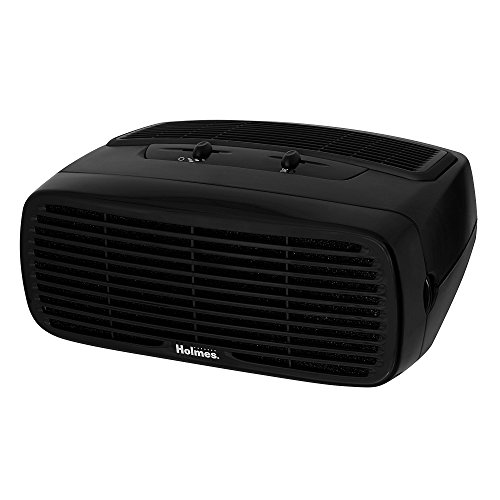
Why this pick: Holmes provides a measured CADR (70) and a small‑room coverage recommendation (109 sq ft). It’s a simple, durable desktop unit with a HEPA‑type filter and optional ionizer, three speeds and a slim profile suited to bedrooms, home offices or dorms.
Notable manufacturer facts:
Best for: small bedrooms, desks and dorm rooms where a measured CADR and compact footprint matter.
Why this pick: frestar targets desk and small‑room use with a USB‑powered design, three‑stage filtration (HEPA + two activated carbon stages), very low claimed noise (30 dB), and low power use (5W). The manufacturer states coverage up to 161 sq ft and replacement HEPA filters are available; this makes it a strong budget pick for near‑personal purification and odor reduction in small spaces.
Notable manufacturer facts:
Best for: students, remote workers and anyone who wants quiet, USB‑powered purification with some carbon for odors in rooms up to roughly 160 sq ft.
Why this pick: QUEENTY supplies an H13 HEPA filter in a compact USB desktop unit with a face‑level air outlet that the manufacturer says targets your breathing zone directly. It lists a low sleep‑mode noise (25 dB), claims “100% No‑Ozone” certification, and includes a 2‑year limited replacement guarantee from the manufacturer.
Notable manufacturer facts:
Best for: users who want true HEPA filtration delivered directly to the head/desk area with minimal noise and USB convenience.
Why this pick: Silanit’s mini purifier is explicitly positioned for portability and odor removal using activated carbon. It’s plug‑in, compact, and includes five replaceable carbon pads that are reusable after air‑drying. That makes it a low‑cost, low‑maintenance option for short‑term odor relief (kitchen smells, travel, dorms) where deep particle filtration is not the priority.
Notable manufacturer facts:
Best for: travelers, renters, smokers or anyone who wants compact odor control and low ongoing cost via reusable carbon pads.
Why it’s in the roundup: this product is an ozone generator intended for deep deodorizing and very large spaces. It is not a HEPA or carbon purifier; it produces ozone gas to chemically react with odors. The manufacturer explicitly states it must be used only in unoccupied, enclosed spaces and ventilated afterwards.
Key manufacturer facts and safety notes (from the product page):
Best for: controlled, short‑term odor treatment in unoccupied spaces (e.g., post‑remodel, vehicle deodorizing); not for continuous use in occupied rooms.
Selection criteria focused on things that matter for day‑to‑day value, especially when the budget is the primary constraint:
We did not include products without manufacturer claims for filter type or coverage. We report only the specs shown in the product records and do not invent test outcomes or price projections.
Here’s what to expect when you compare the picks across real, practical factors.
True / H13 HEPA: BLACK+DECKER, OdorStop OSAP5 and QUEENTY list HEPA or H13 HEPA filters. HEPA is the most reliable way to remove airborne particles (dust, pollen, many smoke particles) when you need particle control.
HEPA‑type and washable: HOLMES uses a HEPA‑type filter and allows an optional ionizer; Silanit’s desktop smoke fan relies on a washable filter for smoke extraction rather than a HEPA cartridge for single‑use particle capture.
Activated carbon: frestar and Silanit include activated carbon stages or pads for odor reduction; OdorStop also lists active carbon in its description. If odor is the primary problem, carbon stages are useful in an occupied space.
Ozone: Manfh is an ozone device intended for deep deodorization of unoccupied spaces; it is not a replacement for HEPA/carbon when continuous, occupied‑space air cleaning is required.
Manufacturer coverage claims vary widely: BLACK+DECKER claims 435 sq ft, OdorStop claims 1,000 sq ft and Manfh claims treatment up to 6,000 sq ft for odor treatments. Smaller desktop models quote much smaller footprints (HOLMES 109 sq ft; frestar 161 sq ft) suitable for desks or small bedrooms. Use a model’s coverage claim as a primary sizing signal — but remember coverage claims often assume a certain number of air changes per hour (BLACK+DECKER specifies 5 ACH in its copy).
Noise is a practical limiter for bedroom/desk use. QUEENTY and frestar both provide quantified low‑noise claims (25 dB and 30 dB respectively). Many cheap models don’t publish decibel ratings, so a low‑power or USB model is the safer bet for quiet operation.
Replacement filters and their lifetimes drive total cost of ownership. BLACK+DECKER indicates filter life up to 2,000 hours and has filter availability; frestar recommends replacement every 3–6 months and lists replacement HEPA filters. Silanit supplies reusable carbon pads, which reduces replacement expenses but also limits efficacy compared with larger carbon cartridges. Many products did not provide explicit yearly filter costs — always check the product page before purchase.
Cheap purifiers vary from pocket desk units to machines that claim whole‑room coverage. Choose by these practical rules:
Practical example: if your bedroom is 120 sq ft, the HOLMES (recommended for 109 sq ft) might underperform relative to a frestar (161 sq ft) or BLACK+DECKER (435 sq ft) depending on real room layout and the pollutant load. If you’re sizing for smoke or heavy cooking odors, prioritize activated carbon content and air circulation over small desktop HEPA units.
A low purchase price is only the beginning: filters, energy use and replacement parts change the long‑term cost picture.
Some models publish power use: frestar lists 5W and USB‑power, which is very low. HOLMES includes a 45W wattage line in its features. ENERGY STAR certification on BLACK+DECKER suggests relatively efficient operation for its size. Lower power is helpful for always‑on background cleaning but check noise specs — a low‑power unit is not always the quietest if fan design is poor.
Because most seller pages do not give explicit yearly filter costs, buyers should verify filter SKU pricing before purchase. The long‑term cost differential between a small HEPA cartridge and more substantial H13 or carbon cartridges can be the largest ongoing expense for a budget purifier.
There are two fundamentally different ways cheap purifiers handle odors: adsorption via activated carbon and chemical oxidation via ozone. The products in this roundup reflect both approaches.
Activated carbon (frestar, Silanit, OdorStop) reduces many household odors and volatile organic compounds by adsorption. It’s safe for use in occupied rooms and is the appropriate first choice if you want continuous odor reduction while people are present.
The Manfh unit is an ozone generator and its product notes make the intended use clear: run only in enclosed, unoccupied spaces; keep people, pets and plants away; ventilate for 30–60 minutes before re‑entry. Manufacturer also notes it isn’t sold in California. Ozone is a reactive gas and should never be used as a continuous air cleaner in occupied rooms. If you have persistent deep odors (e.g., smoke‑saturated fabrics, vehicle interiors) and plan a controlled, evacuated treatment, an ozone generator can produce rapid deodorization — but follow the manufacturer’s safety instructions precisely.
Some small machines advertise ionizers or negative‑ion modes (HOLMES optional ionizer; QUEENTY includes an ionizer while claiming “100% No‑Ozone”). Ionizers may aid particle agglomeration but check certification and manufacturer statements about ozone — some ionizers can generate trace ozone under certain conditions, so only choose units that explicitly certify low/zero ozone output if that is a concern.
Keep expectations grounded. Budget purifiers are useful for many everyday scenarios, but they have real limits:
When in doubt, cross‑check the manufacturer product page for up‑to‑date filter SKUs and replacement pricing before purchase.
These scenarios translate the choices above into practical recommendations.
Choose QUEENTY (H13 HEPA, 25 dB sleep mode) or frestar (161 sq ft coverage, HEP A + carbon, 30 dB). Both are USB/desktop‑friendly with quiet operation; frestar adds carbon for modest odor control.
Consider BLACK+DECKER for a balance of HEPA filtration and a large manufacturer coverage claim (435 sq ft). If you want higher‑class HEPA and still budget‑conscious, OdorStop offers H13 HEPA with manufacturer coverage up to 1,000 sq ft.
Silanit’s mini rechargeable/plug‑in unit with replaceable carbon pads provides compact odor control and low ongoing cost because pads are reusable.
An ozone generator (Manfh) is engineered for this use case — but only for short treatments in evacuated spaces and with careful ventilation afterward. This is not an everyday, occupied‑room solution.
From the products listed here, the BLACK+DECKER Tabletop Air Purifier and the OdorStop OSAP5 are the best cheap options for particle removal because they use HEPA (BLACK+DECKER: HEPA; OdorStop: H13 HEPA). QUEENTY also provides H13 HEPA in a compact form for personal use. Check each product’s stated coverage to ensure it fits your room.
Manufacturer instructions for the Manfh unit state the device must be run only in enclosed, unoccupied spaces; people, pets and plants must be kept away during operation and the area ventilated for 30–60 minutes before re‑entry. Because of these constraints, ozone generators are not suitable for continuous use in living rooms where people are present. Use them only for short, controlled deodorizing tasks and follow all safety guidance.
Look for CADR or an explicit coverage claim with the air‑change assumption (BLACK+DECKER’s copy mentions 5 ACH). If CADR is absent, compare the stated coverage against the filter class and product airflow claims. When in doubt, size up: choose a unit with a higher stated coverage than your room to allow for furniture and imperfect placement.
Yes, for targeted personal benefit. USB and desktop purifiers (QUEENTY, frestar, Silanit) are low‑cost, low‑noise and energy‑efficient for desk or bedside use. They are not substitutes for a larger whole‑room purifier if you need to clean every corner of a room.
Budgeting is product‑dependent. Some manufacturers list filter life (BLACK+DECKER: up to 2,000 hours; frestar: 3–6 months recommended). Silanit includes reusable carbon pads, which lowers recurring cost. Many product pages don’t publish a yearly filter dollar amount — check the product page for replacement SKUs and prices before you buy to understand total ownership cost.
For longer comparisons and deeper buying guidance, see our wider reviews and buyer’s guides: Air Purifier Reviews: In‑Depth Research & Comparisons, Air Purifier FAQ: Every Question Answered, and our budget and room‑specific pages under Best Air Purifiers by Room, Need and Budget.
Cheap air purifiers can provide meaningful benefits when matched to the right use case: USB desktop models for personal breathing zones, small‑room HEPA or HEPA+carbon models for bedrooms and offices, and larger H13‑rated devices where you need whole‑room performance. Always verify replacement filter availability and the manufacturer’s stated coverage before you buy — that’s where low purchase price can turn into a higher lifetime cost.
Product modules above include direct purchase options and Amazon buttons for each pick. Use those links to check the current price, replacement filter SKUs and the most recent customer information for the product you’re considering.
To keep our Best Cheap Air Purifier information accurate, we rely on independent references such as the EPA’s Guide to Air Cleaners in the Home, AHAM Verifide CADR data and manufacturer spec sheets. See how we evaluate air purifiers and our editorial policy for details.
Several models list manufacturer coverage: BLACK+DECKER claims 435 sq ft (based on 5 ACH), OdorStop claims 1,000 sq ft, frestar states 161 sq ft and HOLMES recommends about 109 sq ft. Verify the coverage basis (air changes per hour), your room’s square footage, and expected placement—manufacturers use different assumptions, so check the stated ACH or test conditions before deciding.
Filter-replacement facts in this roundup: BLACK+DECKER lists filter life up to 2,000 hours with an indicator and audible alarm; frestar recommends changing filters every 3–6 months; QUEENTY provides a replacement filter ASIN. The page notes replacement availability for several brands, but you should verify exact replacement part numbers, local availability and filter cost for the specific model you plan to buy.
The guide advises reserving ozone generators only for short, unoccupied odor treatments and following strict safety steps. For routine, occupied-room use, avoid ozone devices. Before buying, verify whether a unit is an ozone generator or explicitly certified “no ozone” (for example QUEENTY claims a “100% No‑Ozone” certification per the manufacturer).
For near‑breath or desk use the roundup highlights frestar (USB, HEPA + activated carbon,
HOLMES is the only unit in this roundup with a reported CADR (70) and a small‑room recommendation (about 109 sq ft). Other models list HEPA class (true HEPA or H13) or manufacturer particle‑removal claims, but CADR is only specified for Holmes here. If CADR matters to you, verify independent CADR testing or look for models that publish measured CADR values.
Prioritize filter availability and clear replacement guidance, safety features (child lock, no‑ozone or explicit ozone warnings), and useful conveniences: sleep mode, timer settings, filter‑life indicator/alarm and energy efficiency (BLACK+DECKER is ENERGY STAR certified). Also consider warranty length and return policies (OdorStop lists a 3‑year warranty and 30‑day money‑back claim; QUEENTY lists a 2‑year replacement guarantee). Verify each feature on the product spec page.
Answers are educational and may link to relevant guides or products on this site. Product facts can change, so confirm current details before purchase.