

QUEENTY
QUEENTY Desktop Air Purifier for office With H13 HEPA Filter,Ionizer,Fac…
BrandQUEENTYFilterH13 HEPA
$30.39
View product details
Product information comes from the current AirPurifierFAQ catalog and should be verified on Amazon before purchase.


This buyer-first roundup is written for shoppers who want the quietest air purifier that actually fits a specific space and use case—bedside, desktop, small room, or large-room coverage. You’ll find picks drawn only from models with manufacturer-supplied specs (noise, filter type, and coverage where available), plus clear trade-offs so you can choose the quietest unit that meets your filtration and room-size needs.
Selection was guided by strict, buyer-oriented rules: we prioritized manufacturer-listed decibel (dB) readings at the sleep/low speed, then filtration type (true HEPA ranked highest), and room-coverage suitability. If a key spec (CADR, dB at low speed, or filter replacement cost) was not supplied by the manufacturer, we flagged it as “Not listed” and did not invent values.
Weighting used during selection (editorial guidance): noise at sleep/low (30%), filtration type/HEPA presence (25%), room coverage suitability (20%), quiet-mode features (15%), and filter availability/upkeep (10%). The result is a compact set of picks arranged by the quietest practical use—desktop/bedside, small room, or larger rooms—so you can match noise performance to how you’ll actually run the machine.
Top pick: QUEENTY Desktop Air Purifier — manufacturer-listed 25 dB in sleep mode, H13 True HEPA filtration, and a face‑level outlet designed for bedside/desktop use. If lowest noise during sleep or focused desk use is your highest priority, this model offers the best stated low-noise combination among the included products.
Why you’d pick it: The QUEENTY lists 25 dB in sleep mode and uses an H13 True HEPA filter. The manufacturer emphasizes a face‑level outlet and oscillating airflow designed to deliver purified air to your breathing zone—features that make it a sensible choice when lowest audible noise during sleep or concentrated desk breathing is the priority.
Trade-offs: Given the compact, USB-powered format and focus on delivering purified air to a single person, expect limited whole-room turnover. CADR is not listed; if you need whole-room purification rates, confirm CADR or coverage before buying.
Why you’d pick it: frestar provides a small-room coverage spec (161 sq ft) and an explicit low-noise number (30 dB). It uses a HEPA + activated carbon combination, runs off USB power, and lists recommended filter replacement intervals—useful if you want quiet operation plus a stated room-fit number for bedrooms or small offices.
Trade-offs: The unit’s small physical size and USB power suggest it’s intended for single‑room use. CADR is not listed—161 sq ft is the manufacturer’s coverage figure, but compare that to the room where you’ll place it. Yearly filter cost isn’t supplied; verify replacement filters and pricing if long-term cost matters.
Why you’d pick them: Two Silanit entries cover slightly different needs: a washable filter desktop smoke purifier fan and a mini rechargeable model with carbon pads. Both are aimed at portability—RV, desk, kitchen smoke removal—and the listings emphasize quiet operation (phrases like “Quiet Dual‑Speed Operation” and “Ultra‑Quiet Fan”).
Trade-offs: Neither Silanit model supplies a manufacturer dB number or room coverage. If you need a verified low-noise spec, contact the seller for measured dB values or choose a model with an explicit dB reading. The washable or reusable elements lower replacement cost but may not filter particles as efficiently as true HEPA versions for fine particulates.
Why you’d pick it: The HimAoto unit uses water as the filtration medium and lists coverage up to 400 sq ft. The manufacturer describes a “whisper‑quiet” low-speed setting that produces rain-like white noise, and it combines humidification and aroma options—useful where you want low audible disturbance and no replacement filters.
Trade-offs: Water-based “air washers” remove some particles and add humidity, but they do not replace HEPA filtration for the smallest airborne particulates. Manufacturer does not provide a numeric dB or CADR; if your priority is validated quiet operation or proven removal of fine particles, verify the product details or choose a model with an H13/H14 HEPA filter and published CADR.
Why you’d pick it: OdorStop’s OSAP5 lists H13 HEPA filtration and a generous manufacturer coverage figure (1,000 sq ft). It offers multiple speeds, auto and sleep modes, and features intended for large spaces. If you need a quiet-capable large-room purifier, the sleep mode is a useful feature—but OdorStop does not list a numeric noise value, so verify the machine’s low‑speed dB before relying on it for very noise-sensitive bedrooms.
Trade-offs: Good coverage and H13 HEPA filtration are strong points; lacking a published dB reading means you should confirm the sleep/low speed noise with the seller if you’ll run it in a bedroom.
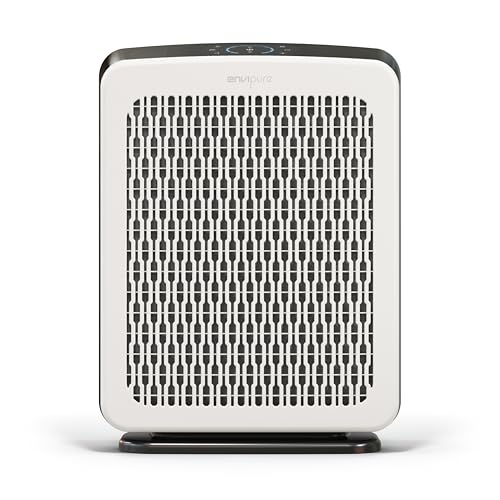
Why you’d pick it: The EP-300 lists coverage up to 2,200 sq ft (at 1 air change per hour), a HEPA filter, smart filter-life monitoring, and an explicit noise number: 55.4 dB. That makes it a practical choice when you need strong whole-house or large room throughput and can accept a higher noise floor for the increased coverage.
Trade-offs: 55.4 dB is substantially louder than the desktop picks; if you need near-silent sleep operation, this model will be louder at many speeds but offers considerably greater coverage. Use it where noise sensitivity is lower (living rooms, open-plan spaces) or confirm that sleep/low-speed noise is acceptable.
Across these picks the clearest pattern is that the quietest manufacturer-listed numbers come from purpose-built desktop units: QUEENTY (25 dB) and frestar (30 dB). Those models trade raw room turnover for very low sound. At the other end, large-coverage models like ENVIPURE list higher decibel levels (55.4 dB) while offering whole-room throughput. Several models advertise “quiet” operation without publishing numeric dB values (Silanit models, HimAoto, OdorStop for noise), which reduces comparability—verify those numbers if you require a specific sound level while sleeping.
Notable gaps in manufacturer data:
Decibels are logarithmic: a 10 dB increase is perceived roughly as about twice as loud. Typical reference points (approximate):
Practical takeaway: a unit rated 25–30 dB at sleep/low will be effectively silent for many light sleepers; a unit rated 50–60 dB will be clearly audible and may be disruptive at night for noise‑sensitive users. Always compare the manufacturer’s stated dB at the same speed (sleep/low) rather than comparing a low-speed dB with another model’s max dB.
When hunting for the quietest purifier, expect to make one or more of these compromises:
Even the quietest purifier will sound louder if mispositioned. Use these practical steps to minimize perceived noise:
Before purchasing, confirm the following items on the product page or with the seller. These are the data points that materially affect whether a model will meet your quietness and filtration needs:
Choose the QUEENTY Desktop Air Purifier (25 dB in sleep mode, H13 HEPA). It’s optimized to deliver purified air at face level and explicitly lists a low‑noise sleep mode. Verify CADR if you need whole-room turnover, but for direct bedside or desk breathing this is the top manufacturer-listed low-noise option in this roundup.
Consider the frestar desktop model (161 sq ft coverage, 30 dB, HEPA + activated carbon). It lists a room fit, a numeric low-noise figure, and USB power. If you prefer filter-free operation and some humidification, the HimAoto water-based unit lists 400 sq ft coverage and a whisper-quiet low speed—confirm noise figures and realize water-based designs differ in particle removal compared with HEPA.
Large-coverage purifiers in this roundup either have higher reported noise (ENVIPURE EP-300, 55.4 dB) or lack published dB values (OdorStop OSAP5 lists 1,000 sq ft coverage but not noise). For large spaces you must accept higher sound or verify low-speed sleep dB before assuming quiet night use. If precise low noise is essential in a bedroom, a desktop or small-room unit near the sleeper is a better choice than a single large unit in another room.
The product listing for the Manfh 2026 ozone generator is included in the available data but is not recommended for occupied spaces. Ozone generators must be used only in unoccupied, ventilated spaces and are not appropriate for continuous home air cleaning while people, pets, or plants are present.
This article reports only the manufacturer-supplied specifications for each listed model. We did not perform independent acoustic testing or CADR measurements. Several entries omit CADR, numerical noise at sleep/low speed, or yearly filter cost; where a spec is missing we have labeled it “Not listed.” If a numerical dB target is essential for your purchase, request the measured sleep/low dB and CADR from the manufacturer or the retailer before buying.
A: Among the manufacturer-supplied specs in this roundup, the QUEENTY Desktop Air Purifier lists the lowest sleep/low noise at 25 dB and is the quietest pick for bedside/desktop use. The frestar desktop lists 30 dB for small rooms. Several larger models either list higher dB or do not publish a numeric low-speed dB; when low noise is essential, pick a model with a published sleep/low dB.
A: Compare dB values at the same operating speed—use sleep/low for night-time comparisons. Because dB is logarithmic, a small numeric difference can be perceptually significant. Also consider the unit’s intended placement: a quiet desktop unit close to your head will often feel quieter than a larger unit farther away running at higher speed.
A: Some water-based air washers operate quietly on low speed and have the added effect of humidifying, but they do not provide the same proven HEPA filtration for very small particulates. The HimAoto model in this roundup lists 400 sq ft coverage and describes a whisper‑quiet low-speed mode—but it does not supply a numeric dB or CADR. Choose based on whether particle removal (HEPA) or quiet humidifying/odor management (water-based) best matches your needs.
A: Replacement frequency depends on filter type and usage. Several product listings recommend HEPA replacement every 3–6 months for small desktop models—check the exact replacement interval and part number on the product page. None of the supplied entries lists a typical yearly cost across models; verify replacement filter pricing and availability before purchasing to budget long-term costs.
A: Ozone generators are not recommended for occupied spaces. They require operation in unoccupied, ventilated spaces and can create health and safety concerns if misused. The Manfh ozone product in the supplied data expressly recommends using the device only in unoccupied spaces and warns that people and animals must be kept away during operation.
If you want a deeper look at long-term maintenance costs, CADR comparisons, or independent acoustic test results, see our related pages:
<
To keep our Quietest Air Purifier information accurate, we rely on independent references such as the EPA’s Guide to Air Cleaners in the Home, AHAM Verifide CADR data and manufacturer spec sheets. See how we evaluate air purifiers and our editorial policy for details.
Selection used explicit editorial weighting: noise at sleep/low speed counted 30%, filtration type/HEPA presence 25%, room-coverage suitability 20%, quiet-mode features 15%, and filter availability/upkeep 10%. We prioritized manufacturer-listed dB readings at sleep/low speed and flagged any missing specs as “Not listed.”
If a manufacturer doesnt supply a dB number we flagged it as Not listed. Manufacturer text (e.g., Silanit or HimAotos "whisper-quiet" language) indicates quiet operation but isnt a measured spec. Verify by contacting the seller for a measured dB at sleep/low speed or choose a model that explicitly lists dB values.
Water-based units remove some particles and add humidity, but they do not replace HEPA filtration for the smallest airborne particulates. The HimAoto lists coverage up to 400 sq ft and a whisper-quiet low speed, but it lacks a numeric dB or CADR. If proven removal of fine particles is a priority, verify details or pick an H13/H14 HEPA model with published CADR.
USB-powered compact units prioritize low noise and portability but typically offer limited whole-room turnover. QUEENTY lists 25 dB and is aimed at bedside/desktop use (no sq ft coverage listed); frestar lists 30 dB and 161 sq ft coverage. Check CADR (if available), room coverage, and replacement-filter availability before relying on them for larger rooms.
The QUEENTY listing includes an ionizer as a feature, but the guide does not provide ozone or emission measurements. If ionizers are a concern for you, verify the manufacturers specifications and any ozone-emission data before buying. Otherwise treat the ionizer as a listed feature alongside QUEENTYs 25 dB sleep-mode and H13 HEPA claims.
Match the purifiers stated coverage or CADR to your room size and how you plan to run it. Some models list coverage (frestar 161 sq ft, HimAoto 400 sq ft, OdorStop 1,000 sq ft), while others omit CADR. Prefer units that publish both a sleep/low dB and CADR for reliable noise and whole-room turnover; if CADR isnt listed, verify coverage or measured CADR before buying.
Answers are educational and may link to relevant guides or products on this site. Product facts can change, so confirm current details before purchase.
