

Manfh
2026 Upgraded High Capacity Ozone Generator Odor Removal Up to 6000…
BrandManfhCoverage6,000 sq ft
Original price was: $46.99.$37.94Current price is: $37.94.
View product detailsProduct information comes from the current AirPurifierFAQ catalog and should be verified on Amazon before purchase.



This roundup is aimed at shoppers who want one practical, buyer‑focused page comparing real 2026 models by room size, filter type, noise and maintenance so they can pick the right unit for their space and budget without sorting through marketing hyperbole. If you need a single, evidence‑based recommendation plus clear alternatives for desktops, travel, smoke/odor and tight budgets, this is the page.
Best overall (2026): OdorStop OSAP5. It pairs an H13 True HEPA filter with a 1,000 sq ft coverage claim, Auto and Sleep modes, five fan speeds and a 3‑year warranty—making it the most practical single buy among the current listings for most whole‑room needs.
This roundup uses only products that are currently listed on AirPurifierFAQ’s catalog for 2026. Selection prioritized: claimed room coverage, stated filter type (HEPA/H13, activated carbon, washable), notable user features (Auto/Sleep modes, timer, USB power), and any manufacturer safety notices (for example, ozone generator warnings). Where a product did not publish CADR or noise figures we mark those fields N/A rather than invent them.
Start by answering two questions: what room are you treating, and what’s the main problem (allergens, smoke/odor, near‑source cooking smoke, or just personal space at a desk)? Size and purpose determine nearly every buying decision.
Choose a model with a listed coverage at or above your room’s square footage. From the current listings:
Match filter technology to the pollutant:
Why it stands out: H13 True HEPA filtration, an activated carbon stage, 1,000 sq ft coverage claim, five fan speeds, Auto and Sleep modes, and a 3‑year warranty. The manufacturer also highlights a 360° air intake design and filter life benefits derived from that intake shape.
Tradeoffs: the product listing does not publish a CADR or noise dB in the supplied data, and filter replacement cost is not stated on the product page provided here—check the product link for current filter options and pricing.
Why consider it: a compact ENERGY STAR certified design with 3‑stage filtration and a manufacturer claim to capture up to 99.97% of particles as small as 0.3 microns in up to 435 sq ft (stated on the product page, based on 5 air changes/hour). Useful features include Sleep Mode, timer options, a child lock, and a filter indicator alarm. The filter life is listed at up to 2,000 hours.
Tradeoffs: CADR and noise dB are not provided in the supplied product data. If you need a larger room capacity, choose the OdorStop instead.
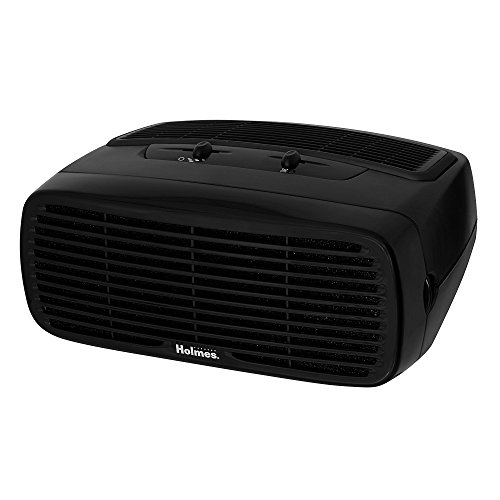
Why consider it: the Holmes desktop unit lists a CADR of 70 and recommends rooms up to 109 sq ft. It includes an optional ionizer and three speed settings, and the manufacturer provides a 3‑year limited warranty—useful if you want a compact, established brand with a published CADR.
Tradeoffs: this is a small‑room device—not suitable for living rooms or open plans.
Why consider it: an H13 True HEPA desktop with an oscillating, face‑level outlet designed to deliver purified air directly to the breathing zone. Manufacturer lists Noise at 25 dB (sleep‑quiet) and includes Sleep Mode; USB power makes this easy to run from a laptop or power bank.
Tradeoffs: designed for personal/desktop use rather than whole rooms. Coverage is not listed in square footage in the supplied data—treat it as a personal purifier.
Why consider it: low price, USB power, HEPA + activated carbon filtration and a claimed coverage of 161 sq ft. The listing states quiet operation below 30 dB and recommends a filter replacement interval of 3–6 months for optimal performance.
Tradeoffs: small capacity and limited carbon volume relative to larger units—better for bedrooms or home offices than open living rooms.
Why consider it: designed to capture smoke and oil‑laden cooking fumes at the source, with a removable oil collection cup and a washable filter—this reduces ongoing filter purchases. USB power and adjustable tilt angle make it practical for kitchens, RVs and small group gatherings.
Tradeoffs: this is a local extractor rather than a whole‑room cleaner; performance depends on placement close to the smoke source.
Why consider it: rechargeable or plug‑in, compact and marketed for travel and dorms, and supplied with five reusable activated carbon pads. Useful for short‑term odor relief in small enclosed spaces such as dorm rooms or hotel rooms.
Tradeoffs: activated carbon pads have limited absorption capacity and are best for light odors. Not appropriate for serious smoke or whole‑room purification.
View Silanit Mini Rechargeable
Use this stepwise checklist to zero in on the right model.
Manufacturers list coverage differently: some use square feet, others show CADR. For the models listed here, use the square‑foot figures (OdorStop 1,000 sq ft, BLACK+DECKER 435 sq ft, HOLMES 109 sq ft, frestar 161 sq ft). If your room is larger than the listed coverage, choose the next larger model or add a second unit for cross‑circulation.
If the primary issue is particles and allergens, prioritize True HEPA / H13. For odors and VOCs pick a unit with activated carbon. For near‑source smoke, use a smoke extractor or a purifier designed for source capture (Silanit smoke fan). For a personal breathing zone, a desktop H13 (QUEENTY) is sensible.
Replacement filters drive long‑term costs. BLACK+DECKER lists a filter life up to 2,000 hours; frestar recommends replacing every 3–6 months. Silanit’s washable element reduces consumable spend. If the product page doesn’t list replacement parts or price, follow the product link and confirm filter SKUs and current pricing before purchase.
If you need quiet overnight use look for Sleep Mode and dB listings. QUEENTY lists 25 dB; frestar lists 30 dB. OdorStop and several others include Sleep Mode but do not publish dB in the supplied data—if nighttime noise matters, check the product page or reviews at AirPurifierFAQ Reviews.
Do not use ozone generators in occupied spaces. The Manfh model is an ozone generator marketed for treatment of odors in unoccupied, sealed spaces up to 6,000 sq ft; the product listing explicitly states the space must be unoccupied and ventilated for 30–60 minutes after treatment and also notes it is not available for sale in California. If you need odor removal for regularly occupied spaces, choose a HEPA + activated carbon unit (OdorStop or frestar) rather than an ozone generator.
Running costs vary with fan speed, filter type and replacement frequency. The supplied product data gives a few useful references:
Before you buy, click through to the product page and confirm filter part numbers and current prices so you can estimate a yearly filter budget. If a listing omits that information, contact the seller or check the retailer’s parts store.
Small desktop units (QUEENTY, frestar) often run quietly enough for bedside or desk use. QUEENTY lists 25 dB in sleep mode; frestar lists noise below 30 dB. Larger whole‑room models may be louder at higher fan speeds; OdorStop and BLACK+DECKER include Sleep Mode for quieter overnight operation but do not supply dB numbers in the provided data. If you need scientific dB comparisons, consult the manufacturer spec sheet or independent reviews on the AirPurifierFAQ Reviews page.
Choose OdorStop OSAP5 if you want a single, higher‑capacity unit with H13 HEPA, activated carbon and practical features (Auto, Sleep, 5 speeds). It’s the most complete single purchase among the supplied 2026 listings for whole rooms.
BLACK+DECKER Tabletop BAPT01 fits mid‑sized rooms up to 435 sq ft (manufacturer’s 5 ACH basis), includes Sleep Mode, timer and a filter life claim (up to 2,000 hours), and is a sensible midrange pick.
QUEENTY desktop (H13, 25 dB) for a quiet personal breathing zone at a desk or bedside. If you want the cheapest USB‑powered small room option, frestar is a low‑cost alternative with HEPA + carbon and 161 sq ft listed coverage.
Silanit Desktop Smoke Purifier is built for local capture, with an oil cup and washable filter—place it close to the cooktop or smoking area. Remember it complements exhaust hoods; it’s not a replacement for ventilation.
Manfh 2026 Upgraded Ozone Generator is marketed for rapid deodorization in sealed, unoccupied spaces up to 6,000 sq ft and includes a timer and “hold” continuous mode. Strong safety caveat: ozone treatments must only be run in unoccupied spaces, and the area must be ventilated for 30–60 minutes before reoccupation. Because of that limitation we do not recommend ozone generators for routine, occupied home use—prefer HEPA + carbon solutions for everyday odor control.
From the current listings the main tradeoffs are:
Ozone is a reactive gas and the Manfh model explicitly states it must be used in an enclosed, unoccupied space and ventilated for 30–60 minutes after treatment; the listing also notes it is not available for sale in California. Ozone is not a substitute for filtration in regularly occupied living spaces. If you want continuous odor control in a home with people and pets, pick a HEPA + activated carbon purifier instead.
For deeper reading and independent test analyses, visit our Reviews hub at Air Purifier Reviews: In‑Depth Research & Comparisons. For common technical questions and a size calculator, see Air Purifier FAQ: Every Question Answered. If your need is allergy or asthma‑focused, consult the sibling pages: Best Air Purifiers for Allergies (2026) and Best Air Purifiers for Asthma (2026).
A: For these supplied 2026 models the OdorStop OSAP5 is the best single pick—H13 True HEPA plus activated carbon, a 1,000 sq ft coverage claim, Auto and Sleep modes and a 3‑year warranty make it the most versatile whole‑room option in the current lineup.
A: H13 is a higher‑grade HEPA rating and is useful if your priority is particle capture—for example pollen, dust and smoke particulates. OdorStop and QUEENTY list H13 HEPA in their product data. If your main problem is odors or VOCs, make sure the unit also includes an activated carbon stage.
A: Ozone generators (for example the Manfh 2026 unit in the current listings) are marketed for deep deodorization in unoccupied, sealed areas. They must only be used in unoccupied spaces and require ventilation before returning people and pets. For routine use in occupied homes, choose a HEPA + activated carbon purifier instead.
A: Replacement intervals vary by model and usage. BLACK+DECKER lists a filter life up to 2,000 hours. frestar recommends replacement every 3–6 months. Some units (Silanit Desktop) have washable filters that reduce consumable cost. Always confirm the manufacturer’s recommendation on the product page and estimate annual costs by checking replacement filter pricing before purchase.
A: Desktop purifiers are designed for personal or very small room use and should not be relied on to clean large living spaces. If you need whole‑room air cleaning, choose a unit with adequate listed square‑foot coverage—OdorStop and BLACK+DECKER provide such coverage claims in the supplied data.
A: Only the HOLMES listing supplied a CADR value (70) in the product data here. For broader CADR comparisons and independent test data, see our Reviews section and consult manufacturer spec sheets linked on each product page.
Before you click buy: confirm the exact model SKU, replacement filter part numbers and current filter prices; check the manufacturer’s warranty and return policy; if noise matters, look for dB figures or independent audio measurements; and, for odor problems in occupied spaces, choose a HEPA + activated carbon combo rather than ozone.
If you already know the room size and primary need, use the quick picks table above to jump directly to the product page and confirm current pricing and availability.
Pick by room size and primary need. OdorStop (H13 True HEPA + activated carbon) claims coverage up to 1,000 sq ft, five fan speeds, Auto/Sleep and a 3‑year warranty—good for whole rooms and open plans. BLACK+DECKER is ENERGY STAR, three‑stage, claims 435 sq ft (5 ACH), up to 99.97% at 0.3 µm, Sleep Mode and a 2,000‑hour filter life—better for medium rooms. Verify CADR, noise, and filter pricing on each product page before buying.
N/A means the manufacturer didn’t publish those figures in the supplied data. When CADR or dB are missing, verify the full product page or contact the manufacturer. In the meantime, use stated room coverage, filter type (True HEPA/H13), features (Auto/Sleep, filter indicator), and warranty to gauge suitability; CADR is helpful but not the only selection factor.
Small USB/desktop units can reduce local airborne particles at close range. QUEENTY uses an H13 True HEPA with an oscillating face‑level outlet (25 dB listed) and is best as a personal purifier. frestar has HEPA + activated carbon and a claimed 161 sq ft coverage with quiet
Activated carbon stages (like OdorStop’s) help adsorb odors and some VOCs and are useful for whole‑room odor control. Small carbon pads (Silanit Mini) can help light smoke/odors at close range but have limited capacity. For near‑source cooking smoke, a local extractor or a capture‑style unit (Silanit Desktop Smoke Purifier) is often more effective. Verify carbon quantity and recommended replacement intervals on each product page.
Ozone generators are intended only for unoccupied, sealed spaces and for treatment purposes. You must evacuate the area during treatment and ventilate thoroughly afterward. They are not suitable for use in occupied living spaces. Confirm the manufacturer’s safety notices and specific usage instructions on the product page before use.
Replacement intervals vary by model: BLACK+DECKER lists up to 2,000 hours; frestar recommends replacing filters every 3–6 months. OdorStop cites filter‑life benefits from its 360° intake but doesn’t list replacement intervals or costs in the supplied data. Check each product’s official page for recommended intervals, filter part numbers, and current replacement pricing—or contact the manufacturer/retailer if not listed.
Answers are educational and may link to relevant guides or products on this site. Product facts can change, so confirm current details before purchase.
