
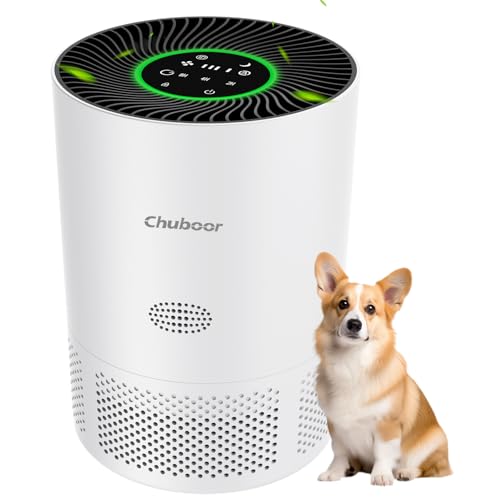
Chuboor
Air Purifiers for Home Large Rooms, H13 True HEPA with Timer
BrandChuboorCoverage1,200 sq ft
Original price was: $44.99.$38.24Current price is: $38.24.
View product details
Product information comes from the current AirPurifierFAQ catalog and should be verified on Amazon before purchase.



This roundup focuses on living-room purchases: owners who need one reliable purifier to cover shared family space, TV rooms and open-plan living/dining areas. If you’re shopping for a small bedroom or a desktop/desk companion, several dedicated portable models below are better fits; if you need whole-house air handling, look to our “Best Air Purifiers for Large Rooms (2026)” page for different scale options. This is a buyer-focused shortlist based on product pages we maintain: specs, coverage claims and feature lists below are taken from those product pages and noted when a spec is missing or should be verified before purchase.
Top pick: Afloia Europa — the best air purifier for most living rooms. It combines a high airflow rating (CADR 280 m³/h), an upgraded laser air-quality sensor with true auto mode, and a near-silent 26 dB sleep setting. That balance of coverage, automatic control and quiet operation makes it the most practical choice for medium–large living rooms where uninterrupted conversation and TV watching matter. See the detailed pick below or check price and full specs.
This page is a buyer-first roundup using products that appear on our site. Selection prioritized models with living-room coverage claims, clear CADR or airflow figures, and features relevant to shared-family spaces: true HEPA filtration, sensor-driven auto modes, low-noise operation, and practical maintenance details. We grouped smaller desktop/portable units separately because they are valuable for spot purification but are not substitutes for a living-room-capable unit unless your living room is the size of a bedroom or you plan to move the unit frequently.
Who it’s for: medium to large living rooms, open-plan living/dining areas, families who want automatic operation and very quiet sleep performance.
Why this pick: Afloia lists a CADR of 280 m³/h, coverage up to 2,000 sq ft, and a near-silent 26 dB sleep mode. The unit includes an upgraded laser air-quality sensor and an auto mode that adjusts fan speed to match the measured pollutant level. Those three factors — meaningful airflow, accurate sensing, and quiet operation — are the primary reasons it’s the best single choice for a shared living room: it will move a lot of air, react to real-time conditions, and not interfere with TV or conversation.
What to expect in daily use: place the Europa near the center of the living space or close to the area where people congregate (so the sensor sees representative air). In auto mode it will run faster when it detects particles; sleep mode reduces fan noise to 26 dB for undisturbed evenings. The product page also lists a three-stage filter (imported materials) suitable for seasonal and pet-related particles.
What to confirm before buying: Afloia’s product page gives CADR and noise figures, but replacement filter pricing and expected filter life are not listed on our product page — check the vendor listing for filter model numbers and cost so you can estimate ongoing ownership expense.
See full product page & current price
Who it’s for: tech-savvy households, people who prefer app and voice control, and anyone who wants scheduled/remote control combined with a large-room airflow claim.
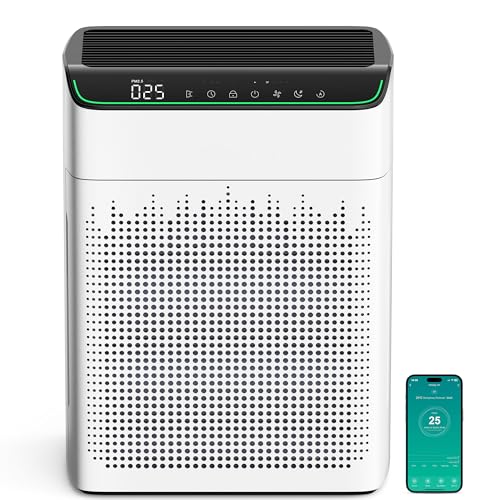
Why this pick: MERONTE lists a Clean Air Delivery Rate of 200 CFM (≈340 m³/h) and coverage up to 1,690 sq ft. The unit supports Wi‑Fi, Alexa and Google Assistant, and has an app with auto and sleep modes. It also includes particle sensing with a 3-color air-quality indicator; the product page claims a very quiet sleep mode (23 dB in copy). For living rooms that are part of a connected home, the convenience of remote control and scheduling can make the purifier more useful day-to-day.
What to expect in daily use: use the dual-sided intake to position the purifier where airflow is least obstructed; the app can reduce display lights and turn the unit to sleep mode at night. The product page says two long-life filters are shipped with purchase, each rated up to 2,200 hours — that helps reduce replacement frequency, but verify the exact filter models and replacement costs before buying.
What to confirm before buying: confirm the sleep-mode noise figure and whether the CADR reporting is for particulate CADR or a vendor-defined airflow metric. Also verify what the included filters are (true HEPA or HEPA-style) and where to purchase replacements.
See full product page & current price
Who it’s for: cost-conscious buyers who need large-area coverage and want a true HEPA filtration claim at a low upfront price.
Why this pick: Chuboor advertises True HEPA filtration, a 360° intake design, and coverage up to 1,200 sq ft with specific cycle times listed for smaller rooms (for example, the product page claims a 120 ft² bedroom can be refreshed every 7 minutes). The price listed on our product page is low, which will draw budget-minded shoppers who prioritize particle capture over advanced sensing or smart features.
Caveat and what to confirm: the product page does not list a CADR number or noise figure. For living-room purchases you should verify CADR (or m³/h) and confirm the stated coverage is based on ACH (air changes per hour) assumptions you accept. If a seller makes large coverage claims without CADR or certification, treat coverage numbers as marketing claims rather than independently verified performance.
See full product page & current price
Who it’s for: this is not a routine living-room purifier. It’s for discrete, unoccupied odor treatments (for example, to treat a closed, empty room after a fire or heavy smoke). It is not suitable for regular occupied‑space air cleaning.
Why it appears on the list: Manfh’s unit markets itself for aggressive odor removal and lists very large coverage (up to 6,000 sq ft for odor treatment) and high output (up to 55,000 mg/hour). The product page explicitly states the unit must be used only in enclosed, unoccupied spaces and warns to ventilate and keep people, animals and plants out during operation.
Important safety note: ozone generators create ozone gas intentionally. Ozone is not a filter and is not safe for occupied spaces; major public health agencies advise against using ozone-generating devices in occupied living spaces because ozone can irritate the lungs and exacerbate respiratory symptoms. We do not recommend ozone generators for routine living-room air cleaning. If you consider a unit like this, read the label closely, follow the manufacturer’s safety instructions, and use it only in appropriate, unoccupied scenarios — and check local regulations: the product page indicates it may not be available for sale in certain jurisdictions (for example, California).
See full product page & current price
Small desktop purifiers are useful for a person’s immediate breathing zone, kitchens, or as a travel/portable option. They are not substitutes for a living-room-capable purifier unless the living room is very small or you plan to move the unit around.
Who it’s for: a bedside or desk companion where quiet operation matters. The product page lists H13 HEPA filtration and a 25 dB sleep mode, plus an oscillating face-to-face outlet designed to direct purified air to the breathing zone.
Practical use: place within a few feet of the seating or sleeping area. Expect limited room-wide benefit; the unit is optimized to refresh your immediate breathing space rather than the entire living room.
Who they’re for: portable odor control, travel, dorms, kitchen countertops and smoke spatter points. Ormos advertises a washable filter (no ongoing filter cost listed), while AuroraTurn and Silanit include multiple activated-carbon pads for odor/volatile-organic-material (VOC) reduction. Noise figures are claimed but vary; Ormos claims 36 dB and QUEENTY claims 25 dB.
Note: activated-carbon pads are limited in capacity; they help with mild cooking or localized smells but don’t substitute for HEPA filtration when particles (dust, pet dander, smoke) are a primary concern in a living room.
Match your choice to the room size, noise tolerance, presence of pets or smokers, and whether you prefer automated or manual control. Below are common living-room scenarios and the recommended picks.
Priority: strong airflow (higher CADR), auto mode, quiet sleep.
Recommendation: Afloia Europa. The combination of CADR 280 and an accurate sensor-driven auto mode makes it a robust performer when the living room opens into other areas. It balances airflow and quiet operation so it can run continuously without disrupting activities.
Priority: app & voice control, long filter life, good CADR.
Recommendation: MERONTE MR5866. For households that want to control the unit from a phone, tie it into routines or use voice commands to lower indicators during movie night, MERONTE’s Wi‑Fi and app features are useful. Confirm the sleep-mode noise figure and actual replacement-filter costs before buying.
Priority: true HEPA filtration and price; accept fewer smart features.
Recommendation: Chuboor PJ01 if you want a true HEPA unit at low upfront cost. BUT: because the product page lacks CADR and noise figures, verify those numbers. If CADR is not available, evaluate the seller’s return policy and user reviews to ensure the coverage claim is realistic for your living-room size.
Priority: true HEPA filtration, frequent filter replacement, adequate airflow.
Recommendation: Afloia or MERONTE depending on room size and whether you want automatic operation. Both list HEPA-stage filtration and suitable airflow claims; check each model’s filter specifications (HEPA class, activated carbon layers) and replacement costs. Desktop carbon-only models are insufficient for particles and dander.
Priority: activated carbon capacity and contact time; avoid ozone in occupied spaces.
Recommendation: For routine cooking or pet odors, choose a purifier with a substantial activated carbon layer combined with HEPA. The portable carbon pad devices (Silanit, AuroraTurn, Ormos) help in immediate localized odor situations but are not room-wide solutions. We do not recommend using ozone generators for occupied living rooms; the Manfh ozone generator is only appropriate for unoccupied treatment scenarios and should be used only per the manufacturer’s safety guidance.
Priority: lowest sleep-mode dB and minimal display lights.
Recommendation: Afloia Europa (26 dB sleep) or MERONTE if you confirm the claimed 23 dB sleep on the full product listing. Desktop options such as QUEENTY (25 dB) are quieter but only benefit the immediate breathing zone.
When comparing living-room purifiers, pay attention to the following:
Even the best purifier works poorly if placed incorrectly. Keep these practical rules in mind:
Ongoing cost is almost always the largest ownership expense after the purchase price. Consider:
Independent certification (e.g., AHAM CADR listing, CARB certification for ozone emissions in the U.S., ETL/UL electrical safety) gives you higher confidence in vendor claims. Where a product lists CADR in m³/h or CFM, confirm whether that CADR is an AHAM-tested value or an internal vendor number. Our product pages show the vendor’s published specs; if independent third-party testing is important to you, look for AHAM CADR listings or refer to third-party reviews on our Air Purifier Reviews: In-Depth Research & Comparisons page.
This is a roundup assembled from product pages hosted on AirPurifierFAQ. We did not perform independent lab testing for this article. We present manufacturer-listed CADR, coverage, noise and feature claims where available and flag missing data. Before you click “buy,” confirm any missing technical details (especially CADR and replacement filter pricing) on the manufacturer or retailer page, and consider the return policy if performance does not meet your living-room expectations.
Short answer: no, not effectively. Desktop purifiers like QUEENTY or Ormos are designed to clean a small breathing zone (desk or bedside) and may not move enough air to substantially reduce particulate levels across a typical living room. Use them as supplements or for very small rooms.
Noise depends on fan speed. Sleep/preset low speeds (25–26 dB on some models) are very quiet and usually acceptable for TV and conversation. Expect louder noise at higher speeds; if quiet evening use is important, prioritize models with verified low sleep-mode dB.
Partially. A unit with a sizable activated-carbon layer will remove many odor molecules. Small portable carbon-pad devices help locally, but for room-wide odor removal combine a HEPA filter with a robust carbon stage for best results. Ozone generators will remove odors chemically but are not safe for occupied spaces and are not recommended for regular use.
No. CADR measures the flow of filtered air and is the best single metric for performance; coverage is often a vendor’s estimate of square footage the unit can handle, sometimes based on lower ACH. Use CADR together with your room’s volume (sq ft × ceiling height) to estimate air changes per hour.
Smaller or lower-cost vendors sometimes omit CADR or present coverage without independent testing. That doesn’t necessarily mean the unit is ineffective, but it does increase risk. When CADR is missing, verify user reviews, returns policy, and seller-provided test data if possible.
For most living-room shoppers we recommend starting with the Afloia Europa for its combination of CADR 280, automatic laser sensing and very quiet 26 dB sleep mode. If smart-home integration and app control are top priorities, the MERONTE MR5866 is a reasonable alternative — confirm sleep-noise and replacement-filter details before purchase. Budget buyers can consider Chuboor’s True HEPA offering, but ask the seller for CADR and noise figures; without them treat coverage claims cautiously.
Desktop and portable purifiers (QUEENTY, Ormos, Silanit, AuroraTurn) are practical as supplements, for travel or for immediate odor control at a countertop, but they are not a substitute for a living-room-capable purifier unless your living room is very small.
Before you click “buy,” measure the room, confirm CADR and filter pricing, and pick a spot that lets the purifier move air freely. If you want deeper, model-by-model testing or independent comparisons, visit our reviews hub at Air Purifier Reviews: In-Depth Research & Comparisons and our general buying guide at Best Air Purifiers by Room, Need and Budget.
Place the purifier near the center of the living space or where people gather so the sensor measures representative air. For units with dual‑sided intakes (like the MERONTE), position it where both intakes aren’t blocked. Also check the product manual for specific clearance and placement recommendations before final setup.
CADR and m³/h describe how much clean air a unit moves; vendors may report CADR in different units or present vendor‑defined airflow figures. Coverage claims often assume a specific number of air changes per hour (ACH). Verify whether the reported figure is particulate CADR, an airflow metric, and the ACH basis used for the coverage claim.
Check the vendor listing for replacement filter model numbers, pricing, and expected filter life. Our product pages note when filter pricing or life isn’t listed (for example, Afloia’s replacement cost isn’t shown). Also confirm whether included filters are true HEPA or HEPA‑style and where to purchase replacements so you can estimate ownership cost.
Smart features (Wi‑Fi, app, Alexa/Google) can increase convenience: remote control, scheduling, and dimming displays help integrate the purifier into daily routines. The MERONTE includes these conveniences and long‑life filters. Before buying, verify which app features, voice platforms, and sleep/auto behaviors the product supports and whether they meet your privacy or automation needs.
Several living‑room picks advertise very quiet sleep modes: Afloia lists 26 dB, MERONTE’s product copy claims 23 dB. However, some models (like the Chuboor) don’t list noise figures. Verify the vendor’s noise specifications for both sleep and higher fan speeds, and consider real‑world reviews if quiet operation during conversation is critical.
Some models claim large coverage (Afloia up to 2,000 sq ft; MERONTE up to 1,690 sq ft; Chuboor up to 1,200 sq ft), but those claims rely on CADR/airflow and ACH assumptions. For very large or whole‑house needs, consult our "Best Air Purifiers for Large Rooms (2026)" page and verify each unit’s CADR, the basis for coverage numbers, and whether multiple units are recommended.
Answers are educational and may link to relevant guides or products on this site. Product facts can change, so confirm current details before purchase.
